
How to Prepare a Roof for a Wet, Windy Winter Ahead
The first real storm of the season rarely waits for a convenient night. Wind pushes rain against your windows, something metal ticks overhead, and you lie there running through everything you meant to check before the weather turned. That instinct is right; you are just early by a few weeks.
Most of the year your roof manages wind and rain as separate, occasional stresses. Winter asks it to hold against strong gusts and shed heavy rain in one afternoon, harder than either stress alone. Getting it ready mostly means finding what you already have loose, worn, or unsecured while you can still check it yourself, then deciding what you hand off to someone who climbs for a living, so the weather never decides for you.
Quick Answer: Preparing a roof for a wet, windy winter means finding what is already loose, aging, or exposed before wind and heavy rain arrive together: mounted fixtures, nearby branches, and fastener points a scheduled pre-winter visit would normally catch first.
Wind and Rain Ask Two Different Things of a Roof
Wind and rain do not stress a roof the same way. Wind is a force problem: moving air creates suction as it passes over a roof, pulling upward on anything not firmly fastened, rather than pushing down as most people picture. Rain is a patience problem: it needs no force, time, and a gap, and a roof that sheds a downpour in an hour can let steady drizzle through eight hours later.
A roof usually faces only one of these at a time, so a small weakness rarely gets tested by both together. A wet, windy stretch removes that gap. Wind loosens a connection that rain then has hours to work on, and rain-softened material gives wind something looser to grab. Preparing well ahead of that overlap is what keeps a roof from developing new problems.
What Lifts First When Gusts Hit a Roof?
Wind does not push evenly across a roof. Air flowing over it accelerates at the edges, the corners, and the ridge, and faster-moving air pulls harder than air moving over the open field. The wind pressure on a roof falls into a predictable pattern for this reason: corners take the strongest suction, edges take the next strongest, and the field between takes the least.
That pattern is why the ridge cap and anything mounted near an edge usually show wear first, long before the middle of a slope shows any real stress. A ridge cap held down by a handful of worn fasteners is asking those fasteners alone to resist the strongest suction anywhere on the roof. Checking the edges and the ridge, instead of assuming a roof that looks fine from your driveway is fine everywhere, is worth the habit.
Roof-Mounted Fixtures Turn Into Wind Hazards When They Are Loose
A roof rarely stays exactly as it left the factory. Over the years, homeowners add a satellite dish, a solar panel bracket, a chimney cap, an antenna, maybe a mounting strip for holiday lighting. Every one of those fixtures is a separate connection to the deck, installed at a different time, and every one is a place wind can find purchase once its mounting loosens. Gutters and downspouts are fastened along the edge the same way, and wind works their hangers loose exactly like any other mounted fixture. A clogged trough, though, waits for rain alone to expose it, backing water up under the roof edge and never carrying it off.
Climbing onto a wet, sloped roof edge to check a mounted fixture or fastener is a real fall hazard, so leave that check to a roofer with proper fall protection. Keep your look to what you can see safely from the ground.
A loose fixture rarely announces itself gradually. A satellite dish bracket that has worked free of two of its four mounting bolts can hold through months of ordinary breeze and then let go completely in one strong gust, at which point it stops being a fixture attached to your roof and becomes a piece of metal thrown across the yard. The same is true of a chimney cap whose clips have thinned with corrosion, or an antenna guy wire anchored to a fastener that backed out years ago and was never noticed, because nothing before had pulled on it hard enough to reveal the problem. None of this fails on a calm day. It waits for the one windy stretch, a pre-winter check, to get ahead of.
Confirming that every added fixture is still fastened belongs on your list before the season turns, not after something has come loose. A five-minute check with your feet on the ground, looking for a bracket that has shifted or a wire gone slack, catches most of this early. Anything needing a closer look is a short job for the roofer already up there for the fastener check.
Overhanging Branches Add Load and Abrasion Before a Storm Ever Arrives
A tree does not need to fall on a roof to damage it. A branch that reaches the roofline scrapes across shingles every time wind moves it, and that light abrasion wears through a protective surface faster than weather alone ever would. In a windy stretch, the branch that brushed all summer gently moves harder and more often.
The heavier risk is the branch that does not just scrape but lands. A limb thickened by growth and loosened by saturated soil is likely to come down in a strong gust, and one falling from real height can punch through more roof than a simple patch will fix. Trimming back anything that overhangs your roofline removes both risks at once.
Sealant and Fasteners Move With the Temperature, Not the Calendar
Sealants and fasteners fail according to a temperature schedule, not a fixed one. Sealant is a flexible material, and flexible materials stiffen as they cool, so a bead that stayed watertight in warm weather can crack under that same movement once the temperature drops. Metal fasteners contract in the cold and expand once the sun returns, and each cycle works a fastener slightly looser than before.
Repeated swings between wet and cold do more of this work than any single freeze ever could, which is why fastener points deserve a check heading into unstable weather, rather than only after a hard freeze. Fasteners exposed to salt-laden air pick up corrosion on top of that fatigue, since corroded metal loses grip faster than clean metal under the same swings. None of this shows up as a leak; it shows up first as a slightly looser fastener your hand can feel.
A Quick Symptom Table for What Is Worth a Closer Look
Not every new sound on a roof means the same thing, and it helps to have a rough sense of which ones are worth a call before the season turns and which can wait for the next scheduled visit.
| What You Notice | What It Usually Means | Who Should Check It |
|---|---|---|
| A new rattle in a gust | A fixture has worked loose | A roofer, at height |
| A branch tapping the roofline | A limb has grown into contact | A roofer or arborist |
| A tick or pop as temperatures swing | A fastener is moving in its hole | A roofer, at the next visit |
None of these signs is an emergency on its own, but each is a specific detail worth mentioning to whoever handles your pre-winter visit, since a roofer who knows what to listen for can find the loose part within minutes.
Booking the Pre-Winter Visit Before the Weather Makes It Unsafe
Timing a pre-winter check is as much about the roof as about the person doing it. A dry, calm day lets a roofer walk the whole roof safely, test every fixture and fastener, and fix small things. Once the wet season has set in, the roof is slicker, the daylight is shorter, and a job that would have taken an hour on a dry morning stretches into a longer, costlier one.
Booking early keeps the visit on a calm day instead of a rushed one squeezed between storms. A roofer with room on the schedule can plan properly; one called in a panic after the first bad night works around whatever daylight is left.
By the time the first real storm arrives, the ridge cap on your roof is not hoping to hold. It is doing exactly what a dozen properly seated fasteners were put there to make it do, resisting the strongest wind on the roof while everything else that could have come loose has already been found, tightened, and checked off a list before the season needed any of it to prove itself.
Frequently Asked Questions
Aim for a dry, calm stretch in early autumn, before the wettest and windiest weeks settle in, so a roofer can still work your whole roof while you watch from your own yard. Waiting until after the first storm means you end up checking for damage that already happened, not heading it off.
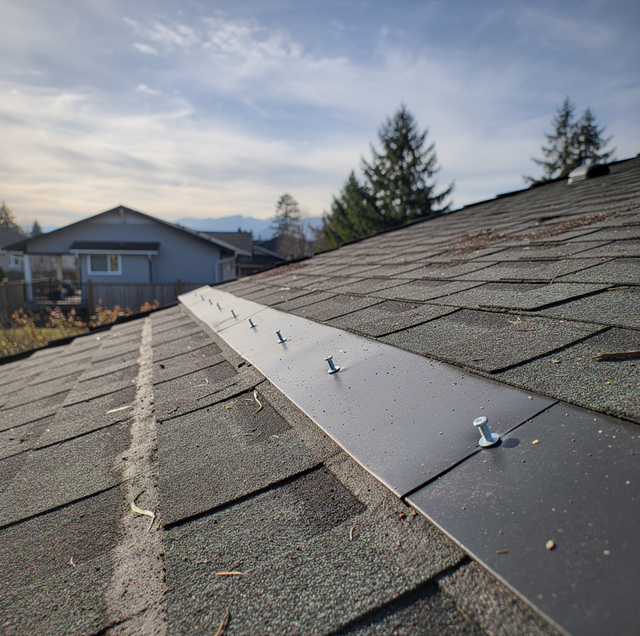
Yes, mostly around the fasteners. If you have metal panels, you will find exposed screws with a rubber washer under each head, holding them down; that washer is the seal keeping water off your deck. A pre-winter check on your roof focuses on washers that have dried, split, or backed out, points where wind and rain reach your roof differently than a shingle one.
Anything added to the roof after it was installed: a satellite dish, a solar mount, a strip of clips left from holiday lights. None of it shows up on the checklist you built around the roofing material, which is why it is worth mentioning at your pre-winter visit, so watch for it yourself.
It usually can, and doing both together makes sense. A roofer checking fixtures and fastener points can flag any branch that is close enough to matter while they are up there, and someone trimming that branch back removes the abrasion risk before your season's wind gets a chance to test it over and over. You save yourself a second trip and get the fuller picture of your roof before the weather turns fully wet.
Yes. Wind stresses fasteners and connections mechanically, working them slightly looser with every strong gust, long before any of that shows up as water. Your roof can carry zero leak history and still have a ridge cap or a mounted fixture running on borrowed fasteners, and a clean record so far tells you nothing about how tight those connections on your roof still are, which is exactly what you want a pre-winter check to find.
It is not too late, but the work gets harder to arrange well. Once the ground is saturated and gusts are frequent, a roofer has fewer calm, dry windows to work in, which can push your simple fastener check out by days or weeks while your roof keeps being tested by exactly the conditions the visit was meant to get ahead of. It is worth booking, even now. A mid-season check that catches one loose fixture before it fails beats skipping the season entirely, and the real difference for you is how much choice you get over timing and working conditions, not whether the check itself is worth doing.
Book a pre-winter roof check — a roofer secures loose-mounted fixtures, tightens fastener points near the edges, trims back any overhanging branches, and confirms the ridge cap itself is still holding fast before the season's first real wind-and-rain event arrives. 3D Established Roofing serves Nanaimo, Lantzville, and Parksville. Call (236) 508-8008.
