
Signs Your Gutters Are Failing (Before Water Reaches the Foundation)
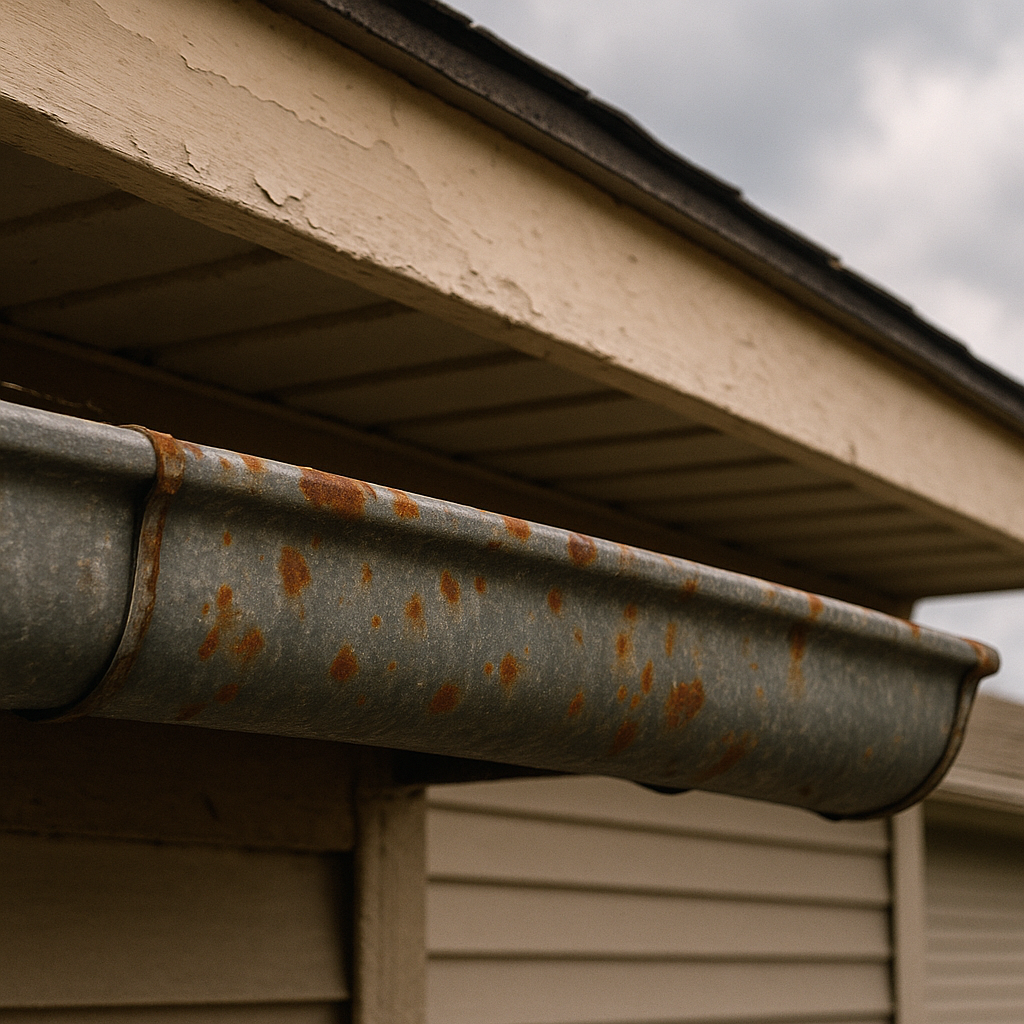
Quick Answer: Failing gutters announce themselves in a handful of ways: water pouring over the front edge during rain, troughs that sag or pull away from the house, visible rust or cracks, paint peeling or dark staining on the fascia and siding below, and pooling water or eroded soil at the foundation. Some of these mean the gutter needs cleaning or re-pitching. Others mean the hardware or the metal itself has given out, and the section needs replacing. Knowing which is which keeps you from repeating the same fix every season.
Gutters do one quiet job: they catch the water that sheets off a roof and carry it to a downspout that drops it well away from the house. As long as they work, you rarely think about them. When they stop working, the water does not disappear. It finds the next path down, and that path runs straight across the parts of the house least able to handle it: the wood at the roof edge, the back of the siding, and the soil packed against the foundation.
The failure is rarely sudden. Gutters degrade over the years, and the early signs are easy to write off as cosmetic. By the time you see a stain spreading down the siding or a soft spot in the fascia, water has usually been going where it should not for a while. Learning to read the signs early is the difference between a cleaning or a small repair and a much larger one that pulls in the roof edge and the foundation at the same time.
How a Working Gutter Actually Fails
To read the warning signs, it helps to picture what a healthy gutter is doing. Water hits the roof, runs down the shingles, and drops off the eave into the trough. The trough is not level. It is pitched, usually a slight slope of roughly a quarter inch over ten feet, so the water is always drifting toward a downspout. The downspout takes it down the wall and, ideally, an extension carries it several feet out before releasing it onto graded soil that runs away from the house.
Think of the whole thing as a shallow river with one job: keep moving water in one direction and dump it somewhere safe. A river backs up when you dam it, when you flatten its slope, or when you punch a hole in the bank. Gutters fail in the same three ways. Something blocks the flow, something kills the slope, or something breaks the channel wall. Nearly every warning sign below traces back to one of those three.
Water Spilling Over the Front During Rain
The most visible sign is a curtain of water pouring over the front lip of the gutter during a steady rain, rather than running quietly to the downspout. It usually means the trough is not moving water fast enough to keep up. A clog of packed leaves, grit, and roof granules is the common cause, but not the only one. If the gutter has lost its pitch, water sits in the low spot and overflows there even when the trough is clear. An undersized gutter, or too few downspouts for a large roof, overflows in heavy rain simply because it cannot carry the volume.
In a consistently rainy climate, gutters see long stretches of steady rain that expose undersizing and lost slope in a way a brief shower never would. The same damp air keeps organic debris heavy and damp year-round, so a trough that drained well when dry stays clogged and slow. The upside of a consistently rainy climate is that overflow shows itself often, so you get plenty of chances to catch the problem early rather than during one rare storm.
Sagging or Pulling Away From the House
A gutter that dips in the middle or leans away from the fascia has lost its grip. Gutters hang from hangers, brackets, or spikes fastened into the fascia board or roof edge. Those fasteners loosen over time, and once one lets go, the water's weight shifts onto the next, and the sag spreads. Standing water makes it worse fast, since water is heavy and a sagging low spot collects even more of it.
The sag also feeds a second problem: it destroys the slope. A gutter that droops in the middle now drains toward the middle, which is exactly where you do not want water pooling. A sag is both a symptom of failing hardware and a cause of future overflow, which is why it rarely fixes itself and usually gets worse each season.
Rust, Cracks, Splits, and Holes
Run your eye along the trough and the seams for rust streaks, hairline cracks, splits at the corners, or actual pinholes. These are signs that the material itself is wearing out rather than just needing adjustment. Steel gutters rust from standing water and trapped debris; aluminum does not rust but can crack, especially at stress points and corners where the metal has flexed through years of temperature swings. Salt air accelerates corrosion of steel components and fasteners, so metal exposed to salt air ages faster than the same metal in a dry, low-salt setting.
A section with a hole or a crack is leaking every time it rains, dribbling water down the wall behind it. Small holes sometimes get patched, but a section that is rusted thin or cracking in more than one place is past patching and is replaced.
Peeling Paint or Staining Below the Gutter
Sometimes the gutter looks fine from the ground, and the evidence is on the wall beneath it. Look for paint bubbling or peeling on the fascia, dark vertical streaks or stains on the siding, or a tide line of dirt where water has been running. These marks are a record of water that escaped the gutter and ran down the house. They point to a leak, an overflow, or a bad seam directly above, even when the trough itself does not look dramatic.
Peeling and staining also indicate that the wood beneath the surface may be absorbing moisture. Paint fails first because it is the outermost layer, but the fascia board it protects is next in line, and once bare wood stays wet, it starts to soften.
Pooling Water and Eroded Soil at the Foundation
Walk the base of the walls after a rain. Puddles that linger against the foundation, soil washed into fans or gullies, mulch pushed out of the bed, or a splash pattern on the lower siding all say water is landing at the base of the house instead of being carried away. This is what a failed or missing downspout extension looks like from the ground. The water made it through the gutter and down the spout, then dumped right at the footing, where it does the most harm.
A Leaking or Separated Seam
Sectional gutters are joined from lengths of metal, and every joint is a seam sealed with a bead of compound. Seams are the weak point because the sealant does what the metal cannot. Over time, it dries out, cracks, and lets go, and the joint starts to weep or drip in the rain. You may see rust or a white mineral streak below the joint, or an actual gap where two sections have pulled apart. A seam is worth checking any time you see a drip that does not line up with a hole in the trough itself.
Debris, Plants, and Disconnected Downspouts
Two more signs are obvious once you look. If the trough is packed with leaves and grit, or you can see grass, weeds, or even a small seedling growing out of it, enough soil and organic matter have collected to hold water and support roots, which means the gutter has not drained properly in a long time. And at the bottom, a downspout that has come loose from the gutter, separated at an elbow, or lost its extension, is dropping water somewhere it should not. All these interrupt the one-directional flow that the system depends on.
Damp Basements and Ice-Dam Damage
Some signs show up away from the gutter entirely. A crawlspace or basement that becomes damp and musty, or shows efflorescence on the walls after wet spells, can be the downstream result of water pooling at the foundation because the gutters never carried it off. In colder snaps, water backing up behind ice at the eave can force its way under the shingles and show up as interior staining, which is one cold-weather stressor among the year-round ones and not the whole story. In milder climates, freeze events are occasional rather than the norm, so ice is a factor to watch in a cold snap, but not the reason most gutters here fail; steady rain, corrosion, and clogging do far more of the damage in a year.
Repair or Replace: Reading the Signs
Once you know the signs, the useful question is which fix each one points to. The split runs along one line. A clog or pitch problem is a maintenance issue: the gutter is sound and just needs cleaning, re-securing, or re-pitching to drain toward the downspout again. Failed hardware or failed material is a replacement issue: rusted-through metal, cracks in more than one place, or a section that keeps failing at the joint, and cleaning it does nothing.
Between those poles sit the fixable middle cases. A single dried seam on an otherwise sound gutter can be cleaned and resealed. A loose run can be re-hung with fresh hangers and re-pitched in the same visit. A downspout can be reconnected and fitted with a proper extension that carries water several feet away from the wall. Guards can be added to reduce debris that causes clogs. The point is to match the fix to the failure, so you are not resealing a seam on a gutter that is rusting out from the inside, or cleaning a trough that overflows because it was never sloped right in the first place.
A word on doing this safely: reading these signs from the ground is fine, but confirming them means a ladder, and much of the work happens at the roof edge on wet, sloped surfaces. Gutter and roof-edge work is a leading cause of falls. If a sign points past a simple cleaning into re-hanging, reglazing seams, or replacing sections, that is work for a professional with proper footing and fall protection, not a homeowner leaning off a ladder in the rain.
Frequently Asked Questions
Capacity is the usual culprit when the trough is clear. A single downspout drains only about 30 to 40 feet of gutter, so a long run served by just one outlet overflows because the water has nowhere fast enough to go. An undersized 5-inch gutter on a large, steep roof hits the same wall, since a steep pitch throws water off the shingles faster than a narrow trough can carry it. Lost slope from a sagging run or a blockage lower in the downspout produces the same spillover. In each case, the fix is drainage capacity or pitch, not another cleaning.
Either the hangers that hold the gutter have loosened, or the fascia board they are fastened into has softened and rotted from chronic overflow, so the gutter loses the anchor it hangs from. Once that anchor gives, the trough droops. The sag then flattens or reverses the slope, so water pools in the low spot and its weight drags the run-down further, which is why a sag tends to accelerate rather than hold steady.
Overflowing water rots the fascia and soffit at the roof edge, runs down behind the siding where you cannot see it, and pools against the foundation, where it can crack the concrete or leak into a basement. That is why a gutter problem does not stay a gutter problem. Left alone, it becomes a roof-edge, siding, and foundation problem at the same time, and each of those costs far more to put right than the gutter did.
A single joint on an otherwise sound gutter can usually be cleaned out and resealed with fresh compound. The catch is that sectional gutters, built from short lengths joined end to end, leak at every joint, so resealing one often just shifts the drip to the next joint. When a run has failed at several seams, it is commonly replaced with a continuous one-piece gutter formed on-site to the length of the wall, which eliminates mid-run joints altogether and leaves only the corners and downspout outlets to seal. At that point, the condition of the metal and the number of bad joints determine whether to repair or replace.
A downspout that has come loose or empties right at the base of the wall dumps the runoff from a whole stretch of roof into one spot against the foundation, where saturated soil presses on the footing and works toward any crack. The reliable fix is to carry that water off: extend the downspout at least 4 to 6 feet from the house, or tie it into a buried drain line that daylights downhill. A splash block alone is not enough where the ground pitches back toward the foundation, because it only redirects the initial splash and lets the rest soak in at the wall.
Guards cut down on the leaves and grit that cause clogs, thereby reducing one common failure mode. They do not fix a gutter that is sagging, undersized, wrongly pitched, or rusting through, and installing them over a failing run can hide the real problem while it gets worse. The slope and the hardware have to be sound first. On that base, guards help; on a failing gutter, they mostly mask the symptom.
Book a gutter inspection — catch a small drip before it reaches your fascia and foundation. 3D Established Roofing serves Nanaimo, Lantzville, Parksville. Call (236) 508-8008.
