
Granule Loss on Asphalt Shingles: What’s Actually Happening
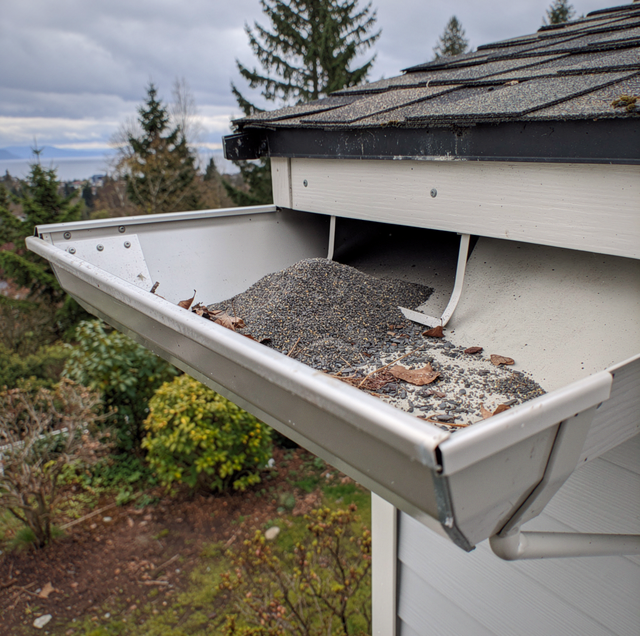
Scoop a handful of grit out of a gutter or from the ground under a downspout outlet, and you're not holding ordinary roof debris. You're holding pieces of the roof itself: gray, black, or brown granules, some no bigger than coarse sand, a few closer to a peppercorn. Every one of those granules used to be pressed into a shingle overhead, and every one now sitting in the gutter is protection the shingle no longer has.
Quick Answer: Granule loss comes from several mechanisms: factory bonding limits, UV and thermal weathering, foot traffic, hail strikes, concentrated water flow, and blistering. The pattern of loss points to the cause more reliably than the amount lost.
What the Granule Layer Actually Is
Each granule starts as crushed rock or slag, screened to a consistent size, and then coated with a ceramic glaze, which is fired onto its surface at high heat. That glaze is what gives a shingle its color, and it holds up to sun and weather far better than raw stone would on its own. Underneath the granules sits a layer of asphalt coating, and underneath that, a fiberglass mat that acts as the shingle's structural skeleton. The granule layer's job: shield that mat and coating from direct ultraviolet exposure. Asphalt left bare under raw sunlight stiffens and cracks far faster than asphalt with a granule layer sitting over it, which is why a shingle that's shed its granules is losing more than its looks.
How the Granules Get Bonded at the Factory
While the asphalt coating is still hot and workable on the production line, granules are pressed into it in a continuous process before the sheet cools, cures, and gets cut into individual shingles. Only part of each granule's surface actually sinks into the coating; the rest stays exposed above it, which is what gives the surface its texture and its color. That bond is strong enough to survive normal handling, shipping, and installation, but it isn't permanent. It's a mechanical grip between two different materials, mineral granule and asphalt coating, and like any bond between dissimilar materials, it weakens under repeated stress rather than holding at full strength forever.
Ordinary Weathering: The Background Loss
Every UV cycle and every swing between a warm afternoon and a cool night flexes the coating underneath the granules, and every flex loosens that bond a little more. That loss doesn't strip a section bald in one afternoon: it works granule by granule, thinning the bond a fraction at a time until the coating starts to show through in whichever spots took the most flexing. A shingle's granules give way the same way, a few at a time, across the whole surface, long before any single spot goes bald.
Cold and heat both work against the bond, just through different mechanics. Cold stiffens the asphalt coating, making it prone to hairline cracking along each granule's edge. Heat softens that same coating and lets granules shift or work loose under their own weight before it firms back up overnight. Neither extreme is the real cause on its own; the repeated swing between them is what does the damage, which is why weathering loss shows up on every roof, in every climate, regardless of the season when someone notices it.
Foot Traffic and Mechanical Contact
Weathering spreads wear evenly. Contact concentrates it. Any weight or scuffing on the surface, a technician working a repair, a branch dragging across the shingles in wind, grinds granules into the coating instead of just loosening them free the way weathering does. A granule ground flat into the coating can still be physically present and still fail at its job, because it's no longer sitting proud enough to block UV or shed heat the way an intact granule does. That's why traffic wear tends to show up as a defined strip or patch rather than the gradual, whole-roof thinning that weathering produces.
Hail and Impact Strikes
A hail strike or a dropped tool does in one moment what weathering does over years: it crushes and dislodges granules at the exact point of contact, leaving a small bruised crater with a concentration of missing granules right at its center. Unlike weathering, which thins a bond gradually, an impact strike can expose bare asphalt coating instantly, in a single storm, at one specific spot rather than across the field of the roof. That immediacy and the tight, localized shape of the mark are usually what separate impact damage from ordinary wear when you're trying to read what caused a given patch.
A hard impact event can strip granules and crack the coating in one storm. That damage isn't safe to assess yourself: a wet or granule-thinned roof risks a fall and grinds granules deeper into the coating. Leave it to a professional.
Where Water Flow Concentrates the Loss
Water doesn't just run off a roof; it carries loosened granules with it, and wherever flow concentrates, it scours the same square inch of shingle every time it rains rather than just during storms. Valleys, where two roof slopes meet and funnel water into a single channel, wear faster than open field areas for exactly this reason. The same is true at the drip edge, where every drop on the roof eventually has to pass, and at the outlet under a downspout, where water arrives already carrying granules picked up higher on the run. On roofs that shed water into one concentrated path, whether from a steep pitch or a large collection area feeding a single valley, that path shows granule loss well ahead of the rest of the surface.
Grit collecting at the downspout outlet tells you more by its edges than by its amount. Freshly loosened granules look sharp and angular, while the same pile turns rounded and dull after a season of rain has worn it down.
Thermal Cycling and Blistering
Moisture or trapped gas that never fully escaped the coating during manufacturing sits under the surface and expands with heat, contracts with cold, and expands again, cycle after cycle, until it finally ruptures the coating in a small blister. When that blister pops, it takes the granules sitting on top of it along with it, leaving a bare spot smaller than a hail strike but with a raised or torn rim instead of a clean dent. The second recognized source works from below: a deck that isn't ventilating properly lets moisture migrate up through the sheathing and press against the underside of the shingle, feeding that same expand-and-contract cycle from the opposite direction. Blistering tends to cluster around whichever of those two sources is actually feeding it, rather than spreading evenly the way ordinary weathering does.
Reading the Rate of Loss
The pattern of missing granules usually says more about the cause than the volume does.
| What You're Seeing | What It Points To |
|---|---|
| Even, gradual thinning across the whole roof | Ordinary UV and thermal weathering |
| A defined strip or patch, not scattered | Foot traffic or mechanical contact |
| A small, tightly bruised crater | A hail or impact strike |
| Bald patches concentrated at valleys, the drip edge, or a downspout outlet | Concentrated water flow |
| A crater with a raised or torn rim | A blister that has ruptured |
None of these mechanisms work alone for long. A roof losing granules to weathering is also more exposed to whatever water crosses it, and a surface already thinned by traffic gives an impact strike less material to absorb before it reaches bare coating. Reading the pattern tells you which mechanism is doing the most damage right now, not which one to rule out.
Frequently Asked Questions
Yes, within limits. Every batch ships with some excess granules that weren't fully pressed into the coating, and those wash free in the first few rain events after installation. That early shed is a one-time manufacturing residue, separate from the ongoing wear this article covers, and it typically tapers off within the first several weeks.
Not necessarily. Darker granule blends absorb more solar heat than lighter blends, which can run the underlying coating hotter on sunny days. Since heat is one of the two thermal extremes that work against the granule bond, a darker roof can show measurable granule loss sooner than a lighter roof installed at the same time under the same conditions.
Not reliably. A slope facing more direct sun takes more UV and heat cycling than a slope facing away from it on the same roof, so two sections installed on the same day can weather at noticeably different rates. That gap can grow wide enough that a roofer inspecting an older roof will sometimes assign the sun-facing slope a shorter remaining service life than the shaded slope right next to it, even though both went on in the same week.
Yes. The mineral layer is part of what earns a fiberglass-mat shingle its Class A fire rating, working alongside the fiberglass mat itself; the asphalt coating sandwiched between them has no meaningful fire resistance on its own. A patch that's gone bald has lost part of that fire protection along with its color.
Manufacturers test that before a shingle ever ships, using a controlled scrub or adhesion test that brushes a sample under set pressure to see how much granule material comes loose. It's a lab process run on production samples, not something a homeowner can replicate or check on an installed roof.
Granules travel suspended in moving water, and they drop out of suspension at the exact point where that water slows down or changes direction, the same physical process that deposits sediment where a stream widens or flattens out. A downspout outlet is one of the few spots on a property where flowing water reliably slows all at once, so it becomes a natural collection point.
Get a granule-loss check from a roofer who knows what the pattern means — not just that granules are missing. 3D Established Roofing serves Nanaimo, Lantzville, and Parksville. Call (236) 508-8008.
