
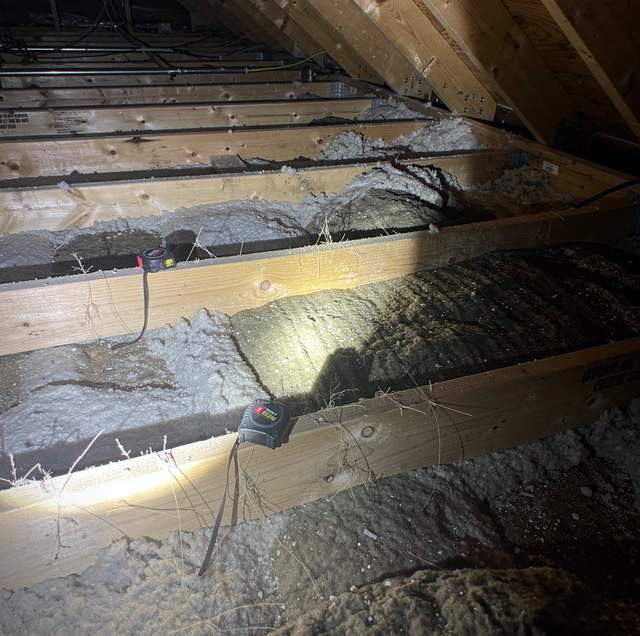
The hatch comes down, and the smell reaches you before the flashlight does: wet wood with something sour underneath it. The beam finds dark blotches on the underside of the roof deck, a grey bloom along the side of one rafter, and a patch of insulation gone flat and heavy. Water is getting into the space above your ceiling, and the question that decides everything you do next is which direction it came from.
Water reaches an attic by one of five routes. It comes through the roof plane or its flashing as bulk water. It rises out of your house as warm, wet air slipping through gaps in the ceiling below you. It blows out of the end of a fan or dryer duct that stopped short of the outdoors. It condenses on a cold pipe or duct running through the attic and drips off. Or it comes up out of a damp crawlspace or basement and rises through the body of the house, because upward is where house air goes. Each route leaves a different mark, and three questions sort them: where the wet sits, when it shows up, and whether the wood is wet through its thickness or filmed on one face.
What the Wet Pattern Tells You First
Bulk water enters at a single place and travels, so it leaves something with a head and a tail. The stain sits darkest near the entry, runs along the underside of a rafter or across the top of a wall plate, ends where the water finally dropped off, and once dry shows a tide line at the limit of its spread. Moisture that arrives as vapor condenses wherever the surface is coldest, so it turns up as an even film across a wide stretch of sheathing, or as beads and frost on the exposed shanks of the roofing nails, and it favors whichever slope gets the least sun through the day.
Bulk water keeps the weather calendar: it appears during or just after a hard rain and can sit dry for weeks in between. Condensation keeps the calendar of temperature and of what you are doing indoors: it shows on a cold, clear night with no rain forecast, worsens in the hour after a long shower, and eases off once mild weather arrives.
Water arriving from above soaks the deck from its outer face and works down through the plywood or strand board, so the wetting shows around a fastener or a panel seam and the wood gives under your thumb through its full thickness. Vapor condensing underneath wets only the face you can see, and the panel behind it stays sound. Insulation reads the same way: a drip from above lands on top of the batts and mats them into a cone under one point, while condensation shedding off the deck darkens a long strip more evenly.
The only footing in an attic is the joists; loose insulation hides them, and a wrong step goes through the ceiling below. Fiberglass and cellulose dust irritate skin, eyes, and airways, so wear a respirator and work off a plank.
Water Coming Through the Roof Plane
This is the route you assume first, and it does happen. Flashing is the common place: the metal at a chimney, a wall junction, or a dormer loses its seal at the joints where two surfaces meet, and neither is continuous. A fastener that missed the framing and worked partway back out over the years opens a small, steady gap that wind-driven rain finds whenever it blows from the wrong side. Where two roof planes meet, the combined runoff funnels into one channel, and anything that dams it gives water somewhere to sit and time to find a seam.
The tell is the head-and-tail pattern, plus the entry point sitting uphill from the drip rather than over it. Water that gets past the deck runs down the rafter until something stops it, so the soaked insulation you find can be several feet to one side of the hole that let it in. Rusted nail heads in a tight cluster, a stain that darkens after rain driven from one particular side of your house, and dry sheathing everywhere else all point the same way.
House Air Pushed Up Through the Ceiling Plane
The ceiling under your attic is not a sealed surface, and it was never built as one. An attic hatch without a gasket leaks warm air around its whole perimeter all day. Recessed light housings that were not rated to seal against airflow let house air past the trim ring at every fixture. The holes drilled through the top plates for plumbing stacks and wiring were sized to pass the pipe and the cable, and nothing closed them afterward. Warm air carries far more water than cold air, and a heated house pushes it up through every one of those openings all winter.
The route gives itself away by clustering. Frost and beading gather directly above the hatch, above a bank of pot lights, or in a line that follows the wall below where the plates were drilled. Pull the insulation back at one of those spots on a cold morning, and the wettest sheathing in the attic is within a foot or two of the opening. The pattern strengthens during a cold snap and fades when the outdoor temperature rises. Ventilation belongs on the list as a cause in its own right, since an attic that cannot move air will condense whatever vapor reaches it, and the intake-and-exhaust balance that governs it is a separate mechanism from the five routes this piece is sorting.
A Fan or Dryer Duct That Stops Short of Outside
A bathroom fan, a range hood, or a dryer pushes a concentrated stream of hot, saturated air down a duct, and if that duct ends inside the attic, all of it lands in one place. The blunt version is a duct never run out at all, left flopping over the insulation above the bathroom. The version that fools people is a duct that was run correctly and later came off its collar at the roof cap, so the cap still looks right from the ground while the duct discharges behind it. A flexible duct sagging between the joists collects condensate in the belly of the sag until a seam splits.
The mark this leaves is a circle. Frost or wet on the deck in a rough disc directly over the appliance, rusted nail tips inside that disc and bright ones outside it, and insulation matted in a ring below. Because the source is a machine you control, you can prove this in minutes: from a safe spot, have someone run the fan while you watch for warm air moving into the attic.
Cold Pipes and Ducts Sweating Inside the Attic
Some of the water in an attic never touches the roof deck. A cold-water line runs above the ceiling, a cooling supply duct with a gap in its wrap, and the plumbing stack carrying warm, humid air up from every drain all present cold surfaces, and air gives up its water to whatever is coldest. The water is not on the deck. It is on the pipe, and it drips from there onto the insulation underneath.
The signature is a puddle-shaped dark patch on top of the insulation with sound, dry sheathing directly above it, reversing everything else on this list. The season reverses too: a cold line or a cooling duct sweats hardest in warm, humid weather, when the deck is bone dry. The plumbing stack works the opposite way, condensing on its inner wall during a long cold spell and shedding that water back down the pipe. Because the wet lands on insulation and soaks sideways, the ceiling stain that shows downstairs can sit well away from the pipe that made it, and that displacement is how this route ends up in front of a roofer.
A moisture meter reading above 20 percent in the sheathing puts that wood in the range where decay fungi become active, and the reading is the same whether bulk water, condensed vapor, or a sweating duct put it there.
Damp Rising From a Crawlspace or Basement
A crawlspace with an exposed soil floor, or a basement with bare porous concrete and nothing drying it, continuously releases water into the air because the ground beneath holds moisture year-round. A heated house behaves like a column: warm air leaves near the top, and replacement air is drawn in near the bottom, so whatever the bottom air carries rises. Your attic receives a vapor load that arrives every day, whether or not anyone showers.
The evidence for this one sits mostly outside the attic. The same musty smell is present at the lowest level of the house. A hygrometer left on the lowest floor reads high and stays high through a cold spell, when indoor air should be drying out. In the crawlspace, you find condensation on the underside of the subfloor, a dark rim joist, and soil damp to the touch under any plastic laid over it. The attic damp is diffuse, stubborn, and still there after the ducts have been run out and the hatch gasketed. When that is what you are looking at, the search moves down through the house rather than up onto the roof.
Frequently Asked Questions
The smell is made of volatile compounds mould gives off while digesting the sugars in wood, which is why an odor can outlast the water that caused it by days. Colonized wood keeps releasing them until it is cleaned or replaced, so a smell that lingers through a dry spell points to growth already established while telling you little about whether the source is still running.
Yes. A reroof replaces what sits above the deck, and sometimes the deck itself, but it does not touch the house below the ceiling, where four of the five routes begin. A second effect catches people out: if the sheathing was replaced during the job, the fresh wood carries no marks, so every historical stain you would have read is gone, and the diagnosis starts from a blank surface.
Many ceilings have a polyethylene sheet stapled across the joists and lapped at the seams, under the insulation, slowing vapor before it reaches cold wood. Where that sheet was cut open for a wiring run or a pot-light retrofit and never patched, or was never installed at all, the ceiling-plane route opens much wider at those spots than the rest of the sheet suggests.
It shortens the list. Foam applied against the underside of the deck brings the sheathing inside the insulated envelope, so it holds near indoor temperature and stops being the cold surface vapor finds. Wet sheathing in a foamed attic points to bulk water from above, or to a supply duct leaking conditioned air into the cavity. Foam also hides a small roof leak longer, since the water tracks behind it before it becomes visible.
No. A storm can drop the outdoor temperature and lift indoor humidity within the same few hours, since windows stay shut and the dryer runs, so a same-day appearance fits either route. Wind direction is the variable that splits them: if the damp turns up only when rain drives against one particular side of your house, water is coming through the roof plane. If it turns up after every cold, wet stretch regardless of direction, the timing is about temperature.
Sheathing that stayed wet through a cold season releases moisture slowly, and weeks of dry, moving air is a reasonable expectation before the wood reads dry again. Staining does not go with it. The dark discoloration sits in the wood fiber permanently, so an old mark proves nothing about whether the problem is live. Outline the edge of a stain in pencil with the date beside it, then look again after the next hard rain and the next cold snap.
A damp attic is worth diagnosing before any repair begins — an inspection that starts inside the attic and works outward names which of these five routes is wetting your deck. 3D Established Roofing serves Nanaimo, Lantzville, and Parksville. Call (236) 508-8008.
