
How Often Should a Roof Be Inspected? A Clear Schedule
Quick Answer: Have a professional inspect most roofs twice a year, spaced about six months apart, plus an extra check after any major wind or hail event. Newer roofs on durable materials can stretch closer to once a year; older or storm-exposed roofs benefit from more frequent looks.
A roof fails slowly, then all at once. For years the damage stays hidden above the ceiling, a lifted shingle here, a hairline crack in sealant there, a fastener backing out a fraction of an inch each season. None of it announces itself. By the time a stain appears on a bedroom ceiling, the water has usually been working through the deck for months. A roof inspection is simply the habit of looking before the damage reaches the part of the house you can see. The question of how often to look has a real answer, and it depends on why roofs go wrong in the first place.
Why Roofs Need Looking At On A Schedule
A roof is not damaged by one thing. It is worn down by a running tally of small stresses that never stop. Wind lifts and flexes the shingles, working fasteners loose and prying at the sealant strips that bond one course to the next. Rain finds every gap that opening creates and tests it, over and over. Sun does the opposite kind of harm: ultraviolet light bakes the oils out of asphalt shingles and dries the flexible sealants around flashing until they shrink, harden, and split. One set of forces pushes and pulls at the roof in wet, blustery weather; the other slowly ages the materials during long stretches of heat and direct light. Both run all year, which is the reason a roof cannot be checked once and forgotten.
Because the wear is gradual and constant, the value of an inspection is catching a defect while it is still small. A single lifted shingle re-secured early is a five-minute fix. The same shingle left through a season of driven rain lets water reach the underlayment, then the deck, and what began as a minor repair becomes a soft patch of rotten sheathing that has to be cut out and rebuilt. Inspection cadence is really a bet about how long you are willing to let an unseen problem grow before someone notices it.
The Sensible Baseline: Twice A Year, Plus After Storms
For most homes, twice a year is the working standard. Schedule one inspection heading into the stormiest stretch of the year, and another once that weather has passed, so the roof gets checked both before it takes a beating and after. The first look catches lifted shingles, loosened flashing, and clogged valleys before heavy weather can exploit them; the second confirms the roof came through sound and sealed. Two looks spaced roughly six months apart mean no defect goes unnoticed for more than half a year.
The other trigger is event-based rather than calendar-based. After any severe storm, a windstorm that strips branches, a hail event, or a stretch of unusually heavy rain, the roof deserves a look regardless of when it was last checked. Storms concentrate a year's worth of stress into an afternoon, lifting or cracking shingles and driving water into seams that were holding fine the week before. Damage from a single bad storm often looks minor from the ground while hiding a breached seal that will leak at the next rainfall.
When Once A Year Is Enough, And When It Is Not: The twice-a-year baseline flexes with the roof itself. A newer roof on a durable material, with no history of leaks and no big trees overhead, can often be inspected once a year without much risk. At the other end, a roof past the midpoint of its expected life, or one shaded by heavy tree cover that drops debris and holds moisture, earns more frequent attention. The right cadence is the baseline adjusted for how much stress the specific roof actually absorbs.
What A Professional Actually Checks
A thorough inspection is not a glance at the shingles. It is a checklist of the specific places roofs tend to fail, worked through one at a time.
- Flashing: The metal at every transition, around chimneys, in the valleys where two slopes meet, against walls and skylights, is where most leaks start. An inspector looks for lifted edges, corrosion, and gaps where the flashing has pulled away from what it seals.
- Sealant and caulking: The flexible sealant around penetrations and flashing edges is a wear item. It shrinks, hardens, and cracks with age and sun exposure, and a split bead of sealant is often the first breach in an otherwise sound roof.
- Fasteners: Nails back out over time as the deck expands and contracts. A raised fastener tents the shingle above it and, on exposed metal, leaves a bare hole where water sits.
- Granule loss: The mineral granules on asphalt shingles are their sunscreen. Bald patches and granules collecting in the gutters signal shingles that are aging out and losing their protection against ultraviolet light.
- Soft or spongy decking: Walking the roof, a trained inspector feels for give underfoot that betrays sheathing already softened by moisture beneath the surface.
- Attic moisture: Much of the real evidence is found inside, not up top. Damp sheathing, water stains on the rafters, daylight showing through a seam, or the musty smell of trapped humidity all point to a roof letting water or vapor through.
The attic part matters because it turns guesswork into evidence. From below, the underside of the deck records every leak as a stain, so an inspector can often locate a breach from inside long before it soaks through to a finished ceiling.
A steep, wet, or mossy roof is not a place to walk. Wet shingles and moss are slick, the fall risk is serious, and roof-surface inspection is work for a professional with proper fall protection. Keep your own checks to the ground and the attic, and hand off anything that means climbing onto a sloped or slick surface.
What You Can Safely Check Yourself, And What You Cannot
There is real value in a homeowner's own eyes between professional visits, as long as the checking stays safe. A steep, wet, or high roof is not a place to walk. Wet shingles and mossy patches are slick; the fall risk is serious, and roof-surface inspection is work for a professional equipped with proper fall protection. The useful homeowner checks happen with both feet on the ground or on solid attic framing.
Ground-Level And Attic Checks Anyone Can Do: On a bright day, look for pinpoints of daylight through the deck, dark stains on the wood, damp insulation, or a musty smell, all signs to bring in a professional. The rule of thumb is simple: eyes and attic are yours to check, but anything that means climbing onto a sloped or slick surface, or probing structural wood, is a job to hand off.
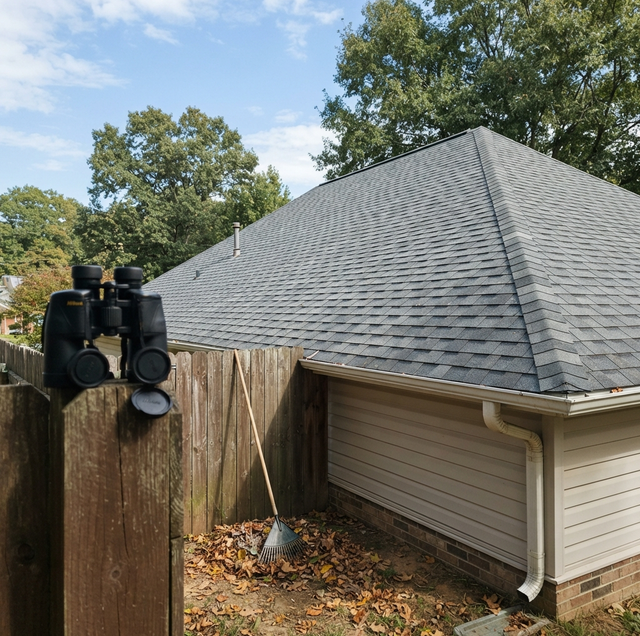
From the ground with binoculars, you can catch a lot: shingles missing, curling, or lying flat where a neighbor's are not, a dark streak of granule loss, or flashing lifted at the chimney. After a storm, check the gutters for shingle grit, since granules collecting there are an early sign the shingles are aging out.
Bringing in a professional at the first sign of trouble is not an admission of defeat. A trained inspector reads subtle cues- a slightly darkened valley, a sealant bead that has just begun to shrink- that an untrained eye slides right past, and does it without turning a minor concern into a fall from a wet roof.
How Age And Material Change The Schedule
Not every roof ages on the same clock, and the inspection schedule should follow the material. A young roof in good repair is forgiving and rarely needs more than an annual look. As any roof crosses the halfway mark of its service life, small failures cluster, sealants everywhere reach the end of their flexibility at once, fasteners loosen across whole sections, and the case for twice-yearly inspection grows stronger the older the roof gets.
Material sets the base rhythm. Asphalt shingle roofs show their age through granule loss and curling and hold to the standard cadence. Metal roofing tends to shift the attention toward fasteners and the sealant washers under them, which can loosen or dry out and need checking before the panels themselves wear. Cedar and other wood roofs, prone to splitting, cupping, and moss in damp conditions, generally reward closer and more frequent inspection than a comparable asphalt roof. Knowing which failure mode your material is prone to is what turns a generic schedule into the right one for your house.
What Neglect Actually Costs
Skipping inspections does not save money. It defers a small, known cost into a large, unknown one. A breach that a routine inspection would have caught as a lifted shingle instead spends a full season letting water into the assembly. Water reaches the underlayment, then wicks into the plywood or oriented strand board deck, which softens and begins to rot. Wet framing invites mold, and the trapped moisture ruins the attic insulation, which loses much of its insulating value the moment it gets damp, so heating and cooling costs quietly climb while the ceiling stays dry enough to hide the problem.
The endpoint of long neglect is the difference between a repair and a replacement. A roof caught early needs a few shingles and a bead of fresh sealant. The same roof ignored for years needs new decking, new underlayment, and sometimes framing repairs, along with the interior finishes the water reached on its way down. Regular inspection is the cheap habit that keeps a roof in the first category. Skipping it is how roofs quietly slide into the second.
Consider the schedule the way you would the oil in a car. Nobody waits for the engine to seize before changing it; the whole point of a maintenance interval is to act while everything still looks fine. A roof inspection is the same principle applied overhead: a routine look that keeps a good roof good and finds the one small thing before it becomes the expensive thing.
Frequently Asked Questions
Yes, and the first inspection window matters more than people expect. Many manufacturer warranties require proof of professional maintenance to stay valid, so a brand-new roof still benefits from a look within its first year to confirm the installation is holding and to start the paper trail. Early inspections also catch workmanship issues, such as a mis-nailed course or an under-lapped valley, while they are still the installer's responsibility to correct.
A typical single-family roof inspection runs about forty-five minutes to an hour and a half, depending on the roof's size, pitch, and complexity. A steeper roof with multiple valleys, dormers, and skylights takes longer because each of those transitions is a separate flashing detail to examine. Ask whether the inspection includes a written report with photographs, since a written record is what lets you track how a small issue changes between visits.
Drone inspections are increasingly common and are especially useful for steep or fragile roofs that are unsafe to walk, giving a close overhead view of shingles and flashing without foot traffic. Their limitation is that a camera cannot feel for soft decking underfoot or press on a suspect flashing seam, and it cannot inspect the attic at all. A drone is a strong supplement to a hands-on and interior inspection, not a full replacement for one.
A pre-listing inspection is worth arranging, because a roof problem discovered during the buyer's inspection almost always costs more than one you found first. Buyers and their inspectors treat an unaddressed roof issue as a bargaining chip, and lenders sometimes require roof repairs before a mortgage closes. Knowing the roof's condition ahead of listing lets you either fix issues on your own schedule or price them in honestly rather than negotiating under pressure.
Early morning and late afternoon, when the sun sits low, are best because raking light throws long shadows that reveal surface irregularities a flat midday sun washes out. Lifted shingles, minor sagging, and uneven areas cast visible shadows in that angled light. For the attic side, the opposite is true: pick a bright midday hour so any pinholes or gaps in the deck show up as clear points of daylight against the dark wood.
Moss is a signal worth acting on, because it is not just cosmetic. Moss holds moisture against the shingles, and its root-like structures work under the shingle edges, lifting them and creating channels for water. A visible moss colony, or a valley packed with leaf debris that dams water, is reason enough to schedule a professional look, since both trap moisture exactly where a roof is most vulnerable to it.
Book a seasonal roof inspection — catch the small problem before it becomes a new roof. 3D Established Roofing serves Nanaimo, Lantzville, and Parksville. Call (236) 508-8008.
