
Why Does My Roof Flashing Leak — and Why Recaulking Fails
Quick Answer: Most roof leaks start where flashing meets a wall, chimney, skylight, or vent, not in the open field of shingles. The usual causes are dried-out sealant, corroded or badly installed metal, a cracked rubber pipe boot, or loose counter-flashing. Recaulking hides it for a season because sealant is only a backup; the fix is flashing that sheds water by overlap and gravity.
The stain shows up on the ceiling a few feet from the chimney. You get up in the attic with a flashlight, run a bead of caulk over the joint that looks suspect, and for a few weeks it holds. Then the next stretch of heavy rain arrives, the brown ring darkens, and you are back where you started. If that loop sounds familiar, the problem almost certainly is not the caulk. It is the flashing that the caulk was trying to rescue.
What Flashing Actually Does
Shingles handle the wide, flat parts of a roof well. What they cannot do is seal a corner, a seam, or a spot where the roof surface stops and something else begins. Flashing is the thin metal (usually aluminum, galvanized steel, or copper) that bridges those joints and steers water back out onto the shingles below, where the field can carry it to the gutter.
Look at where the metal lives and you will see the pattern: where a roof plane meets a wall, around the base of a chimney, along the sides of a skylight, at the collar of every plumbing vent pipe, and down the valleys where two roof slopes meet. Those transitions are exactly where a roof is most vulnerable, which is why most leaks trace back to them and not to a hole in the open shingle field. When water finds a way into your house, the odds strongly favor a failed transition over a failed shingle.
Here is the part that trips people up. Flashing is not supposed to be watertight the way a sealed pipe is. It works by overlap and gravity; each piece laps over the one below it, so water is always handed downhill onto a surface that sends it away. Think of shingles on a roof, or scales on a fish: nothing is glued shut, yet water runs off because every layer sits on top of the next in the direction of the flow. Sealant is a secondary line, meant to close small gaps at the very top edge. When the overlap is right, the caulk barely matters. When the overlap is wrong, no amount of caulk saves it. That is the whole reason recaulking keeps failing: you are asking a backup to do the primary job.
The Real Reasons Flashing Leaks
Several different failures all appear as the same brown stain, so it helps to know what distinguishes them.
Dried and cracked sealant: This is the most common and the most misdiagnosed. The bead of caulk or roofing cement at the top edge of a flashing gets baked and soaked in cycles for years, hardens, shrinks, cracks, and pulls away from one side. People see the gap, refill it, call it fixed, and repeat it every year or two. The recaulking works briefly because it plugs the last few millimeters of the path. But if the metal underneath is doing its job, the sealant should never have been carrying the load in the first place. A joint you have caulked more than twice indicates the flashing beneath it needs attention.
Corroded or rusted-through metal: Old galvanized steel flashing eventually loses its coating and rusts, and once a pinhole opens, water walks right through it. In a damp, salt-air environment, this happens faster; constant moisture and airborne salt chew through fasteners and thin metal sooner than they would in a dry inland climate. A flashing that looks chalky, pitted, or orange-streaked is near the end, regardless of how much caulk sits on top of it.
Flashing that was never integrated properly: Good flashing is woven into the roof and the wall, tucked under the layer above and lapped over the layer below. A shortcut install instead surface-mounts the metal on top of the shingles or the siding and relies on a fat bead of sealant to seal the exposed top edge. It looks fine on day one. It leaks the day the sealant fails, because there was never a real overlap behind it. Face-nailed flashing, where nails pierce the exposed surface of the metal, adds a row of holes right in the path of the water.
Missing or reversed step flashing: Where a roof slope runs alongside a wall (think of a dormer or the side of a raised section), the correct method is step flashing: a series of small bent metal pieces, one tucked behind each course of shingles, each lapping the one below like steps. If a piece is missing, installed upside down, or replaced with a single long strip of bent metal, water sneaks behind it and runs down into the wall. This one is sneaky because the stain often appears well below the actual gap.
A cracked or hardened pipe boot: Every plumbing vent that pokes through the roof wears a collar (usually a neoprene rubber gasket seated in a metal flange) that hugs the pipe to keep water out. Rubber does not last as long as the roof. These boots commonly harden and split somewhere around the ten-to-fifteen-year mark, and once the rubber cracks, water runs straight down the outside of the pipe and into the ceiling. A visibly split or cupped collar around a vent pipe is one of the easiest leak sources to confirm from the ground with binoculars.
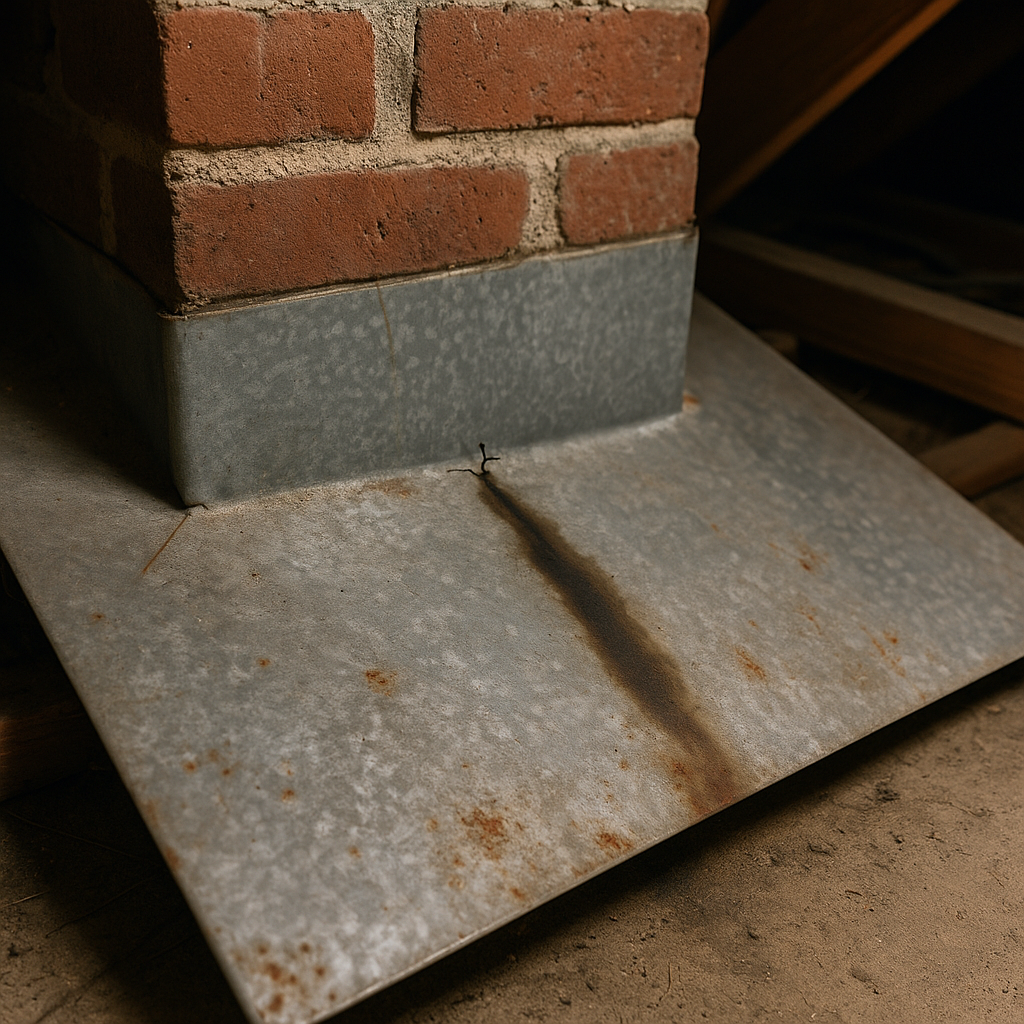
Loose or lifted counter-flashing at a chimney: A chimney uses two layers: base flashing that laps up onto the brick, and counter-flashing whose top edge is set into a cut groove (a reglet) or a mortar joint and folded down over the base flashing. Over time, the mortar erodes, or the metal works loose, the top edge lifts, and rain driven sideways gets in behind it. Chimneys leak more than almost anything else on a roof, and this is a big part of why.
A valley overwhelmed or dammed with debris: Valleys carry the combined runoff of two roof slopes, so they move a lot of water fast. Fir needles, moss, and leaf litter pack into a valley and build a small dam; water backs up, spreads sideways, and slips under the shingle edges. In a damp climate where moss and organic debris are constant, a clogged valley is a genuine repeat offender.
Wind-driven rain and backed-up water: Even sound flashing can be beaten by the weather. Rain pushed uphill by a strong wind can climb under a lap that would shed a straight-down shower with no trouble, and debris or ice sitting on the roof can pond water above a flashing until it finds a seam. Relentless rain and gusts off the water drive moisture at these joints from every angle, so a joint that is merely adequate inland can leak here.
How to Tell Which One You Have
You can narrow it down a lot without setting foot on the roof.
- Where the stain sits, a leak that lands near a chimney chase, an exterior wall line, a skylight, or a bathroom vent almost always indicates flashing issues at that feature. A stain marooned in the middle of a ceiling, away from any roof penetration, is more likely to be something other than flashing.
- Whether it tracks with the wind, if the leak only shows up during storms blowing from one direction and stays dry in calm weather, you are probably looking at wind-driven water getting under a lap or behind a lifted counterflashing, a sign that the overlap, not just the caulk, is the issue.
- What the boot looks like: A pipe boot is the one cause you can often confirm yourself: a cracked, cupped, or gap-ringed rubber collar around a vent pipe, visible from the ground with binoculars, is a near-certain culprit.
A word on safety before you go looking. A wet or steep roof is no place to diagnose a leak, and a wet climate keeps roofs damp and slick for much of the year. Do your detective work from the ground and from inside the attic. A flashlight during a rainstorm often reveals exactly where water enters and the path it travels. Leave anything that requires being on the roof to someone with the footing, gear, and experience to be up there safely.
Why Recaulking Is Only a Bandage
It is worth saying plainly, because it saves people years of the same chore. Sealant is a consumable backup, not the waterproofing. It sits at the top edge to close a small gap, and it is expected to age out. When you recaulk a leaking flashing, you refresh the backup while leaving the real defense (the overlap and the condition of the metal) untouched. If the metal is corroded, mis-lapped, or missing a step piece, the caulk buys you one dry season, and then the leak returns, usually a little worse because water has been working behind the scenes the whole time. Redoing the flashing so it sheds water on its own is what actually ends the cycle.
Frequently Asked Questions
You can, and it may quiet a minor leak for a season, so it is a reasonable stopgap before a repair. But treat it as buying time, not fixing the problem. Caulk at a flashing edge is only meant to close a small gap; it is not designed to hold back water on its own. If the same joint needs recaulking again within a year or two, that is the flashing itself signaling it needs to be reset or replaced. Repeated recaulking also lets water keep working out of sight, so a small fix can quietly become a rot repair.
The neoprene collars commonly harden and split after about 10 to 15 years (sooner with strong sun exposure), while the roof around them still has plenty of life left. When one fails, you do not need a new roof; you replace the boot. Longer-lived options exist, including boots with a lead sleeve you fold down over the pipe and newer designs with a replaceable rubber ring or an adjustable metal collar, several of which are built to outlast standard neoprene. Matching the new boot to the pipe diameter matters, since an oversized collar will not seal.
Water rarely drips straight down. Once it gets past the flashing, it lands on the roof deck or a rafter and follows that wood along its slope until it hits a low point (a seam, a nail, a light fixture) and finally drops through the ceiling. That travel can carry a leak several feet, even to the far side of a room, from its true entry point. It is why chasing the stain rarely finds the source, and why a flashlight in the attic during rain, tracing the wet track back uphill, beats guessing from below.
In most cases, yes. Flashing at a single chimney, skylight, wall, or vent can be removed and rebuilt while the surrounding shingles stay in place, since the repair is local to that feature. The shingles immediately around the flashing usually have to be lifted and reset to properly weave the new metal in, but that is a small area, not the field. The exception is a roof already near the end of its shingle life, where it can make more sense to address the flashing as part of a fuller reroof rather than twice.
It depends on the flashing's condition, and it's worth deciding on purpose rather than by default. Sound metal flashing, especially copper or heavy galvanized, can outlast a set of shingles, so on a reroof, it may be good enough to keep. But reusing old flashing to save a step is a frequent source of leaks on an otherwise new roof, because bending it back and forth to lift the shingles fatigues the metal, and old sealant rarely reseats well. Valley and chimney flashing are cheap to replace while the roof is already open, and expensive to fix once new shingles are laid over them. In a wet climate, it also pays to have the flashing and its sealed joints looked at every few years between roof jobs, since the caulked seams give out long before the metal does.
A chimney stacks up the hardest conditions on a roof in one spot. It has the most joints (front, back, both sides, plus the counter-flashing set into masonry), and that counterflashing depends on mortar or a cut groove that erodes and loosens over the years. On top of that, brick and metal expand and contract at different rates through heat and cold, so every temperature swing works the seam a little looser. Add a chimney's habit of interrupting water flowing down the slope, forcing it to divert around the sides, and you have the single most leak-prone feature on most roofs.
Book a flashing inspection before the next stretch of rain — and stop refilling the same leak every year. 3D Established Roofing serves Nanaimo, Lantzville, Parksville. Call (236) 508-8008.
