
What Causes Shingles to Lift or Blow Off? The Two Bonds That Fail
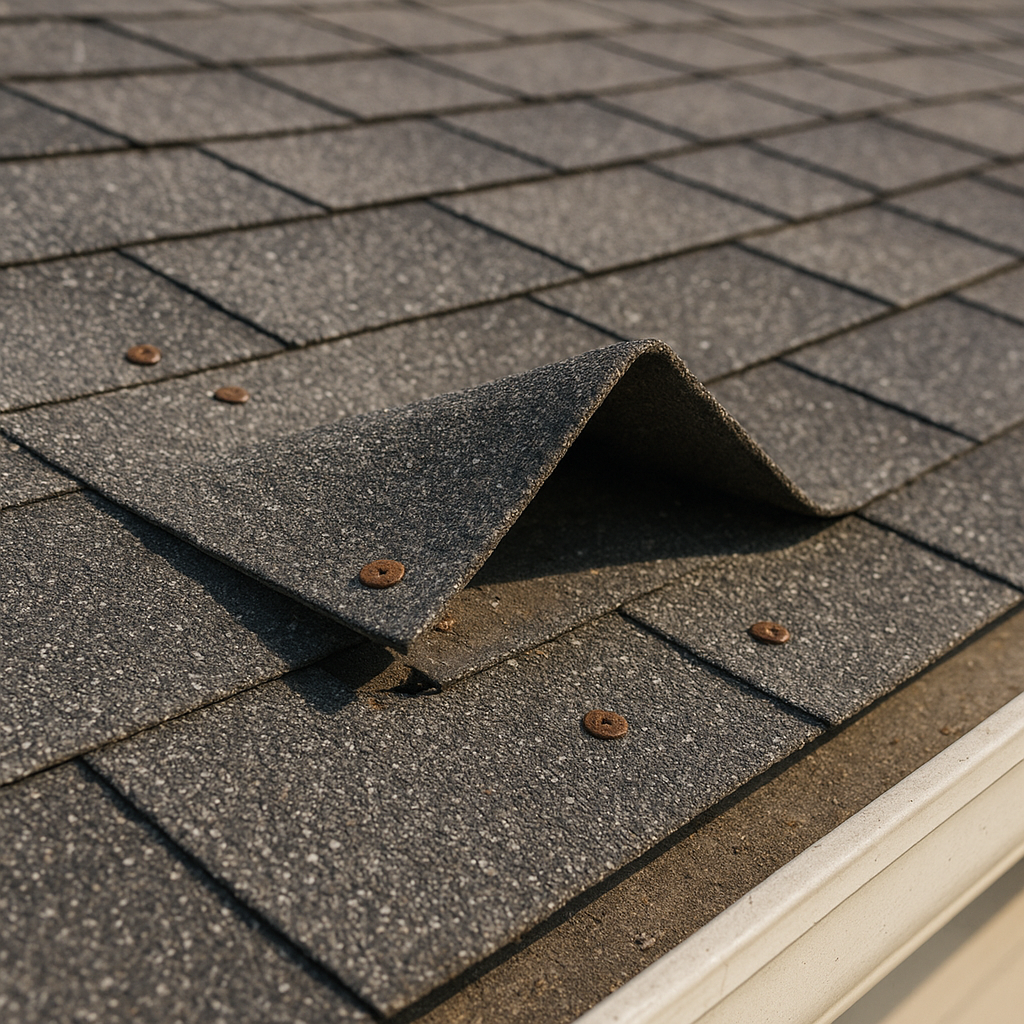
A single shingle standing up on your roof looks like a small thing. It is not. That lifted tab is the leading edge of a problem that spreads, and understanding why it happened tells you whether you are looking at ordinary wind damage or a defect that has been sitting on your roof since the day it was installed.
Quick Answer: Asphalt shingles stay flat because of two separate things working together: the nails that fasten each shingle to the deck, and a self-sealing adhesive strip that glues each shingle to the one below once the sun warms it. Shingles lift or blow off when one of those two bonds fails, from bad nailing, a seal that never set, age, or wind prying under an unprotected edge.
The Two Things Holding a Shingle Down
Two independent systems hold every asphalt shingle on your roof, and both have to work.
The first is nailing. Each shingle course is fastened with nails driven through a narrow band called the nail line, which the manufacturer marks on the shingle face. When the next course goes on above it, those nails sit hidden under the overlap of the shingle above. That overlap is the whole point. A correctly placed nail secures the shingle; it passes through and pins down the top edge of the shingle below, so every shingle is held by its own nails and captured by the course above it.
The second system is the sealant strip. Run your eye across a shingle, and you will find a thin band of adhesive, either along the top face or the underside, depending on the product. It is a heat-activated glue. When the roof warms in the sun, that strip softens and bonds to the shingle course sitting on top of it. Once it sets, each shingle is effectively laminated to its neighbor. This seal turns a field of loose, overlapping tabs into a single wind-resistant surface.
Think of it like roof tiles held by both a peg and a dab of glue. The peg keeps the tile from sliding off, and the glue keeps the wind from flapping its loose edge. Pull either one, and the tile becomes vulnerable in a way it was not before.
When a shingle lifts or blows off, one or both of these systems has failed. The rest of this comes down to figuring out which.
How the Nailing Goes Wrong
Nailing is the most common installation-side reason shingles come loose, and it can fail in more than one way.
Too few nails is the simplest. Most three-tab and architectural shingles require four or more nails per shingle, and high-wind applications require six. A crew moving fast might place fewer, which leaves the shingle underfastened and easier for the wind to work loose.
Overdriven and underdriven nails are subtler. An overdriven nail is sunk too deeply, so the head cuts into or tears through the shingle mat instead of clamping it. An underdriven nail stands proud, holding the shingle above it up off the deck and creating a bump that wind can catch. In both cases, the nail is present but not doing its job.
Then there is high nailing, sometimes called overdriving's cousin in blame. The nails are placed above the marked nail line, up in the exposed portion of the shingle rather than in the reinforced strip. When nails sit too high, they miss the top edge of the shingle above, so that the course below is no longer pinned to the upper shingle. It is held only by its own sealant strip. Break that seal, and nothing will keep it down.
How the Seal Fails to Set
The sealant strip requires specific conditions to bond, and several factors can prevent it from bonding.
Cold-weather installation is common, with a roof often going on during a cool, damp stretch. The adhesive needs warmth to activate. Shingles laid in cold conditions may not bond until a properly warm spell arrives, sometimes not that season, leaving the roof exposed in the meantime.
A dirty surface stops the glue cold. Dust, pollen, sawdust, or debris on the shingle face where the strip is supposed to bond acts as a release layer. The strip touches the grit rather than the asphalt and never fully grips.
Stacking damage happens before the shingles even reach the roof. If bundles sit under weight or in heat, the sealant strip can bond to the wrong face of the shingle above it in the stack. Pulled apart on the roof, that strip has already used up its tack and will not seal properly to its intended neighbor.
And once bonded, a seal can still be broken. Anything that lifts a shingle after the fact, foot traffic during other work, a branch dragged across the roof, or an earlier gust that peeled a tab and let it fall back tears the adhesive loose. A seal that has been broken rarely re-bonds on its own.
Age, Wind, and the Edges
Two more forces act on the shingles that were installed perfectly.
Age works on both the sealant and the shingle body. Over years of heat cycling, the adhesive dries and loses its grip, and the asphalt mat itself grows brittle. An older roof can have shingles that are still nailed fine but no longer sealed to each other, so they flutter loose in the wind that a newer roof would shrug off.
Wind does its damage at the edges first, and this is where roof geometry matters. Air flowing over a roof creates uplift, and that suction is strongest at the eaves, the rakes along the gable ends, and the ridge. These are also the places where the first and last shingles sit, with their exposed edges facing the weather. If those edges were finished with a proper starter strip, a course of adhesive-backed material bonding the first shingles down along the perimeter, the wind has nothing to grab. Without it, the wind slips under the exposed edge, lifts the first shingle, and then works its way inward, peeling course after course like a page.
A wet, windy climate cuts both ways here, and this is worth saying plainly. It is easy to blame a single storm, but the stress is year-round. Constant wind flexes shingle edges in every season, not just during the loudest gales, and persistent damp keeps sealant surfaces from curing as cleanly as they would in a dry climate. The roof that holds up is the one built to resist steady uplift all twelve months, not the one that merely survived a stormy stretch.
Why One Lifted Shingle Matters
The reason a single lifted tab deserves attention is that roofs fail progressively, not all at once.
When one shingle lifts, it stops protecting the shingle below it and exposes the nail heads of the course beneath. Wind now has a bigger edge to grab and pushes harder on the next tab in line. Water gets a path it did not have before, running under the lifted shingle and reaching the underlayment or the deck. A seal that broke on one shingle also means its neighbors are carrying more of the wind load than they were designed to.
So the lifted shingle you can see is rarely the whole story. It is the visible symptom of a bond that has let go, and left alone, it recruits the shingles around it into the same failure.
Telling Wind Damage From an Installation Problem
You can often read the cause off the pattern, and the distinction changes what needs to happen next.
A handful of lifted or missing tabs after a truly strong blow, clustered along one edge or one slope facing the wind, usually points to wind damage on an otherwise sound roof. The rest of the field is sealed and nailed fine; the weather found a few weak spots.
Shingles lifting across the whole roof, or in neat horizontal rows, tells a different story. When failure follows a straight line, it is tracking the nail line or the sealant strip, which means the problem was built in. Rows of loose shingles point to high nailing or a seal that never set across the job, not to any one storm. Widespread failure is an install or age signal, not a weather one.
That difference matters because the fixes differ. A few wind-lifted tabs can be resealed or replaced individually. A roof failing in rows has a systemic issue that spot repairs will not solve.
What Actually Keeps Shingles Down
The measures that prevent lift are the same ones that separate a careful install from a rushed one.
Proper starter strips along every eave and rake give the perimeter shingles a bonded edge so wind cannot get underneath. Correct nail count and placement, the right number of nails driven flush and squarely on the nail line, secures each course and captures the one below. Wind-rated shingles carry a manufacturer's wind classification and a more aggressive sealant designed for exposed sites. In cool installs, hand-sealing, placing dabs of roofing cement under each tab, holds shingles down until the sun-activated strip can take over. And prompt repair of any lifted tab stops the cascade before it starts.
None of this is something to test by climbing up yourself. Roof work is a professional job, and a wet or steep roof is seriously dangerous underfoot. Damp asphalt shingles and persistent moisture make for slick footing, and the fall risk is real. If you can see lifted shingles from the ground or an upstairs window, that is your cue to call someone who works on roofs for a living, not to go up after it.
Frequently Asked Questions
The sealant strip is a band of heat-activated adhesive on each shingle that bonds to the course below once the sun warms the roof. It fails in three main ways: it never sealed in the first place, usually because the roof was installed in cold weather or the surface was dusty when the shingles went down; it dried out and lost its grip with age; or it was mechanically broken by a prior lift and never re-bonded. Once broken, that strip rarely re-seals on its own, and the shingle relies entirely on its nails.
The nail line is a marked strip running across the shingle, and newer shingles add a reinforced nailing band along it so the fasteners bite into a tougher layer. High nailing means the nails land even half an inch above that strip. When they sit that high, they miss the overlap of the course above, so the shingle sitting on top is no longer pinned by the one below it. That upper shingle then rides on its sealant strip alone, and once the seal releases, wind can peel each shingle in turn.
A starter strip is a purpose-made shingle with a factory-applied adhesive bead running along the eave and rake, and its job is to bond the first row down. Skip it, and the field shingles' cutouts line up over the seams right at the edge, leaving open gaps where wind can get a grip. From there, the uplift slips under the exposed edge, lifts the first shingle, and works inward, course by course. The starter shingle also shifts the adhesive bead outboard of those cutouts, so no open seam sits at the perimeter.
Yes. The adhesive on the sealant strip requires warmth to activate and bond, so shingles installed during a cold stretch may not seal until the next warm spell arrives, which can be weeks or even a full season later. During that gap, the roof is more vulnerable to wind. To bridge it, crews doing cold-season installs use hand-sealing, placing dabs of roofing cement under each tab by hand to hold the shingles down until the sun-activated strip finally sets.
Look at the pattern and the tabs together. Random single tabs with clean creases after a big blow read as wind, since each tab folded back sharply under a gust and left a crisp fold line. Uniform rows lifting, or a whole slope letting go, point to a nailing or sealing defect instead. Watch for tabs that detached without any crease at all: a tab that simply slid free rather than folding usually never bonded or was nailed high, which is an install signal rather than a weather one.
Yes. A lifted tab exposes the nail heads beneath it to water, creating a direct leak path down to the deck. Once the sealant bond has broken, it will not re-bond on its own in cool weather, so the tab keeps flapping through every gust. That means the fix is to hand-seal it with a dab of roofing cement or replace it, and doing so before the next windy stretch stops the failure from spreading to its neighbors.
Book a roof inspection before the next windy stretch — catch a lifted shingle before it becomes a leak. 3D Established Roofing serves Nanaimo, Lantzville, Parksville. Call (236) 508-8008.
