
What Is Roof Flashing? The Quiet Guard at Every Seam
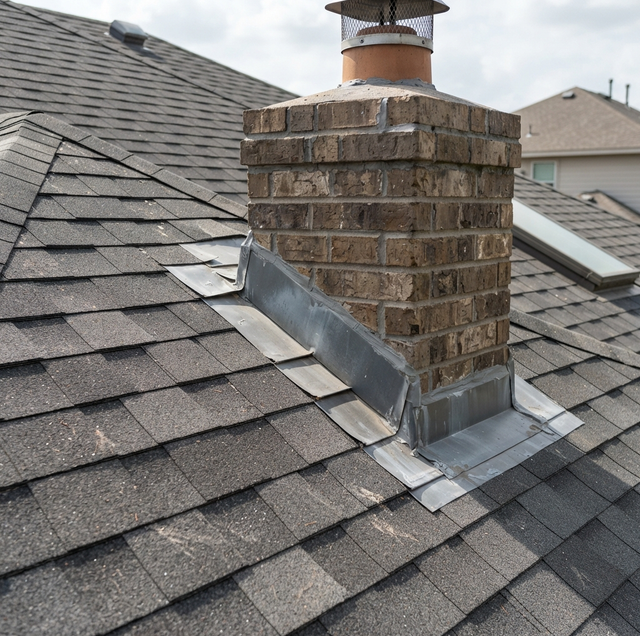
Quick Answer: Roof flashing is the thin metal (and sometimes membrane) that seals the joints, edges, and penetrations on a roof, the exact spots where shingles alone cannot keep water out. Instead of relying on shingles to bridge a gap next to a wall, chimney, or vent pipe, flashing overlaps the layers so water is directed off the roof rather than into it. It is one of the most important parts of a roof and one of the least visible.
Most people think of a roof as a field of shingles, and out in that open field, shingles do their job well. Water hits them, runs downhill, and drops off the edge. The trouble starts wherever that clean field is interrupted. A wall rises through it, a chimney breaks it, a plumbing vent pokes up, two roof planes crash together in a valley. At every one of those breaks, the shingles stop being a continuous surface, and a gap opens where water can find its way underneath. Flashing is what closes those gaps.
Where Water Actually Attacks a Roof
Before the types of flashing make sense, it helps to know where a roof is truly vulnerable. Rain rarely gets in through the middle of a healthy shingle. It gets in at the transitions.
Any place two surfaces meet at an angle, water wants to pool and wick sideways instead of running straight off. Any place something passes through the roof- the pipe, the chimney, the skylight- leaves a seam around it. Any place the roof plane ends, at the eaves and rakes, water tries to curl back under the edge. These transitions are where a roof leaks, and they are exactly the places flashing is built to guard.
Flashing works by lapping. Each piece tucks under the layer above it and over the layer below, so gravity keeps water moving down and across the metal rather than finding a path in. That overlap, done in the right order, is the whole principle. Get the order wrong, and the same metal that should shed water starts funneling it inside.
A helpful way to hold the idea: flashing is the collar and cuffs of a raincoat. The main fabric sheds plenty of rain on its own, but the collar and cuffs are stitched and layered so water can't run down your neck or up your sleeve at the openings. A roof's openings need the same treatment.
The Key Flashing Locations and Types
Different transitions call for differently shaped flashing. Most roofs use several of these at once.
Step Flashing (Roof Meets Wall): Where a sloped roof runs alongside a wall, such as where a lower roof meets the side of a second story, step flashing does the work. It is a series of L-shaped metal pieces, each bent to hug both the roof and the wall. One piece is woven in with every course of shingles as the roof is built, so the flashing steps up the wall alongside the shingles. A single long strip of metal cannot do this job. The layered steps are what let water shed from one piece to the next.
Counter Flashing (Cap Flashing): On masonry, like a brick wall or chimney, counter flashing sits over the top of the step flashing. It is set into a groove cut in the mortar joint (a reglet) and bent down to cover the top edge of the step flashing underneath. Its job is to keep water from running down the wall face and slipping in behind the step flashing. Step and counter flashing are a pair: the step piece handles the roof-to-wall seam, the counter piece caps it from above.
Valley Flashing (Two Roof Planes Meet): A valley is the trough where two roof slopes come together, and it carries a lot of concentrated water during any storm. Valley flashing is a wide metal channel laid down in that trough before the shingles, giving the fast-moving runoff a smooth, watertight path to the gutter. Because valleys move so much water, a weak valley shows itself early.
Chimney Flashing (Base, Step, and Counter): A chimney needs the most complete flashing of anything on a roof because water attacks it from four sides. The uphill side gets base or apron flashing to shed water around it. The sides get step flashing woven into the shingles. And counter flashing set into the chimney's mortar caps the whole assembly. A chimney flashed with a single bead of sealant instead of this layered metalwork is one of the most common leak sources on any home.
Vent Pipe Boots and Flashing: Every plumbing vent that pokes through the roof needs a boot, a flashing piece with a flat base that slides under the shingles above and a collar or rubber gasket that seals tightly around the pipe. The flat base is woven into the shingle courses so water sheds over it. The rubber gasket at the pipe is often the first part to dry out and crack, which is why vent penetrations are a frequent leak point on otherwise sound roofs.
Skylight Flashing: A skylight is a hole cut in the roof with a window set in it, so it needs its own flashing kit, apron below, step pieces up the sides, and a head piece above, much like a small chimney. Many skylight leaks don't trace to the glass but to reused, patched, or never fully integrated flashing when the unit was installed.
Drip Edge (Eaves and Rakes): Drip edge is the metal strip along the bottom edges (eaves) and the sloped edges (rakes) of the roof. It kicks water out past the fascia so runoff drops cleanly into the gutter instead of curling back under the shingles and rotting the wood edge of the roof. It is a small piece that protects the entire perimeter.
Kick-Out Flashing (The Commonly Missed Spot): Where a roof-to-wall seam ends at the bottom, right above a gutter, kick-out flashing does one specific thing: it diverts the water running down the step flashing sideways into the gutter, instead of letting it pour straight down the face of the wall behind the siding. It is a small angled piece, and it is skipped far too often. When it is missing, water runs behind the siding trip after trip and rots the wall framing out of sight, sometimes for years before anyone notices a stain inside.
Headwall and Apron Flashing: Where the top of a roof slope runs straight into a wall (a headwall), apron flashing bridges the seam. It is bent to sit on the roof and up the wall, tucked under the wall's siding or counter flashing above and over the shingles below, so water coming down the wall is carried out onto the roof surface rather than in behind the shingles.
What Flashing Is Made Of
Flashing is chosen to last as long as the roof and to stand up to constant water. A few materials do most of the work.
Aluminum is light, easy to form, and rust-resistant, which makes it common for step and drip edge. It should not sit directly against fresh masonry or dissimilar metals, which can corrode it over time.
Galvanized steel is stronger and holds its shape well, and is often used for valleys and chimneys, though its zinc coating can eventually wear and let rust start.
Copper is the longest-lived option and is often chosen for chimneys, valleys, and high-end roofs. It costs more, but it can outlast several shingle roofs and develops a protective patina rather than failing.
The right material also depends on what it touches, since some metals corrode when paired with others, and a roofer matches the flashing to the roof and the surfaces around it.
Why Flashing Fails
Flashing rarely fails because the metal simply wore out on its own. It usually fails for one of a few avoidable reasons.
Corrosion is one. Years of water, especially where dissimilar metals touch or a coating has worn through, can eat pinholes and rust lines into older flashing. A second and very common cause is the sealant-only "repair," where a past leak was smeared over with caulk or roofing tar rather than the flashing being reworked. Sealant is not flashing. It shrinks, cracks, and lets go, usually within a couple of seasons, and the leak returns.
Improper installation is the other big one. Flashing that was face-nailed through its exposed surface, laid with reversed laps so an upper piece sits under a lower one, or installed without being woven into the shingle courses will channel water inward no matter how new the metal is. And the missing kick-out flashing already described belongs on this list, because its absence is a silent, ongoing failure rather than a sudden one.
Weather does play a role, but it works year-round rather than in one season. Freezing and thawing can flex and lift poorly fastened metal in the cold months, while heat and constant wet-dry cycling dry out gaskets and work sealant loose the rest of the year. A roof faces some version of this stress in every month, which is why sound flashing matters all year and not just in a storm.
The Warning Signs of Failing Flashing
Flashing problems tend to announce themselves inside the house before you ever see the metal.
Inside the attic, water or dark staining found specifically around a penetration, a pipe, a chimney base, or a skylight curb tells you the seal around that opening has let go. Shingles that look lifted or loose right along a wall or valley often mean the flashing underneath has shifted. Because kick-out failures hide behind siding, soft or discolored siding low on a wall below a roofline deserves a close look too.
Catching any of these early matters. A flashing leak that drips into a wall cavity can rot framing and feed mold long before the damage shows, so a stain that seems minor is worth having looked at.
A stain near a wall, chimney, or fireplace points to flashing, not the open field of shingles, since those are the flashed transitions. Rust streaks running down from a chimney or valley, or attic staining around a pipe or skylight, tell you the seal at that opening has let go, worth checking before it rots the framing.
Flashing Is Built Into the Roof, Not Stuck On It
The single most important thing to understand about flashing is that it is woven into the roof system, not applied on top of it afterward. Each piece is layered into the shingle courses and the wall in the correct order, so the roof sheds water as one continuous system. That is why a tube of caulk over a leaking seam is a stopgap and not a fix. It may buy a dry week, but the water is still finding the gap, and the caulk is only hiding it until it cracks.
Reworking flashing means lifting shingles, removing the old metal, and rebuilding the laps in sequence, which is roofing work done at height on a slope. Roof and edge work is a genuine fall hazard and belongs to trained pros with the right footing and fall protection. The lasting repair is the metal, integrated back into the roof, done by someone equipped to be up there safely.
Reworking flashing means lifting shingles and rebuilding the metal laps at height on a slope, which is a genuine fall hazard. A wet or steep roof should never be walked to chase a leak, and poking at flashing from a ladder is far more likely to get someone hurt than to fix the problem. Leave this work to trained pros with proper footing and fall protection.
Frequently Asked Questions
Often yes, if the surrounding shingles are still in good shape. A roofer can lift the shingle courses around a chimney or wall, swap the failed flashing, and re-lay the shingles over the new metal. The exception is a roof near the end of its life: brittle shingles tend to crack when they are lifted, so on an aging roof the flashing is usually renewed as part of a full reroof rather than on its own.
Drip edge is a functional part of the roof, not decorative trim. Without it, runoff wicks back under the first course of shingles and rots the fascia and the roof deck's edge, and gutters can pull water behind themselves. Many current building standards call for it at eaves and rakes, and leaving it off is a shortcut that shows up as edge rot years later.
A reglet is the narrow groove cut into a masonry joint that counter flashing tucks into. It matters because counter flashing set into a proper reglet and sealed is far more durable than flashing merely surface-mounted to brick with sealant. If a chimney's counter flashing was only glued to the face of the brick, expect it to peel away and leak within a few years.
It depends on the metal. Aluminum and galvanized flashing are often designed to last through one shingle roof's life, while copper can outlast two or three. The catch is that flashing only reaches its lifespan if it was installed correctly; a reversed lap or a face-nailed piece can fail in a fraction of the metal's rated life regardless of the material.
Most skylight leaks are flashing leaks, not glass leaks. The usual culprit is flashing that was reused from an old install, patched with sealant, or not stepped properly up the sides of the curb. Water works in at the head or the sides and shows up as a stain on the interior frame or the ceiling below, which is easy to mistake for a failed seal in the glass itself.
Yes. A metal roof panel sheds water across its field, but it still has valleys, walls, chimneys, vents, and edges, and every one of those transitions needs flashing detailed for a metal system. The flashing profiles differ from those on a shingle roof, but the principle is the same: the panels handle the open surface, and flashing handles the seams.
Chasing a stubborn stain near a wall or chimney? Let us find and rework the flashing before the framing pays for it. 3D Established Roofing serves Nanaimo, Parksville, and Vancouver Island. Call (236) 508-8008.
