
What Roof Underlayment Does: The Layer That Saves Your Deck
Shingles get all the attention because they are the part you can see from the street. But a shingle roof is a system of layers, and one of the quietest members of that system does more to keep water out of your house than most homeowners realize. That layer is the underlayment.
If you have ever wondered what sits between your shingles and the wood of your roof, or why a roofer talks about "felt" and "peel-and-stick" during an estimate, this walks through what underlayment is, where it sits, and why the type your roofer chooses matters.
Quick Answer: Roof underlayment is a water-resistant sheet installed over the roof deck and under the shingles. It acts as a secondary barrier, so if wind, ice, or a damaged shingle lets water past the top layer, the underlayment keeps that water off the wood and out of the house.
Where Underlayment Sits In The Roof
A pitched roof is built in order, from the structure up. First comes the roof deck, usually sheets of plywood or oriented strand board nailed across the rafters. That deck is the skeleton, but bare wood is not waterproof and swells the moment it gets wet.
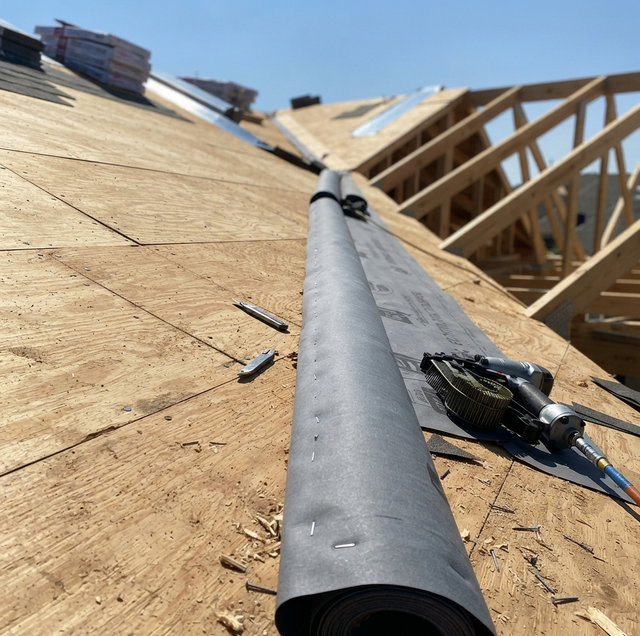
Underlayment goes on next, rolled or sheeted directly over the deck and fastened down before any shingles are installed. Only then do the shingles go on top, overlapping down the slope so most water runs off the surface and never reaches the layer below.
So the stack, from the inside out, is: deck, underlayment, shingles. The shingles are the raincoat. The underlayment is the sweater underneath that keeps you dry if the raincoat springs a leak.
Why a secondary barrier exists at all: Shingles shed the vast majority of water, but no shingle roof is perfectly sealed. Wind can drive rain sideways up under the edges. A branch can crack a shingle. Fasteners create small openings. Underlayment exists precisely because the top layer is not expected to be flawless for every hour of its life. It is the plan for the water that does get past.
The Main Types Of Underlayment
Roofers work with three broad categories, and a single roof often uses more than one at the same time, each placed where it does the most good.
Asphalt-saturated felt: Felt is the traditional underlayment, a paper or fiberglass mat soaked in asphalt to make it water-resistant. It comes in two common weights: #15 (the lighter, thinner roll) and #30 (heavier and more tear-resistant). Felt has been used for generations and still performs, though it is heavier per roll, absorbs some water over time, and can wrinkle or tear if it sits exposed to sun and rain before the shingles go on.
Synthetic underlayment: Synthetic underlayment is woven or spun from polymers such as polypropylene or polyethylene. Compared with felt, it is lighter, stronger against tearing, and holds up far better if a job is paused with the underlayment exposed. Most rolls have a printed non-slip surface to give crews better footing, and one roll covers more area than the equivalent felt, so fewer seams end up on the deck. It has become the default full-coverage choice on many shingle roofs.
Peel-and-stick ice-and-water membrane: This is the heavy hitter. Ice-and-water membrane is a rubberized asphalt sheet with a sticky back that bonds directly to the deck once the release film is peeled away. Its defining trait is that it self-seals around nails: when a fastener punches through, the membrane grips the shank so water cannot travel down the nail. Because it is more expensive and fully adhered, it is used in the spots that take the most abuse rather than across the whole roof.
Where Each Type Goes On The Roof
Matching the material to the location is where roofing craft shows up.
Full-coverage field: The large open planes of the roof, the "field," get either synthetic or felt rolled edge to edge, lapped so each course sheds onto the one below. This is the broad backup layer under the shingles.
Valleys, eaves, and penetrations: The trouble spots get peel-and-stick membrane. Valleys, where two slopes meet, funnel a large volume of water into a narrow channel and are a classic leak point, so they are lined with membrane. Eaves, the lower edge, are where meltwater and backed-up water tend to sit, so a course of ice-and-water membrane along the eave gives that band extra defense. Anywhere something pokes through the roof- a vent pipe, chimney, or skylight- gets membrane worked around it because those cutouts are hard to keep watertight with shingles alone.
Low-slope sections: The flatter a roof section is, the slower water drains and the longer it lingers, which raises the risk of leaks. Roofers often extend membrane across low-slope areas, or the whole section, because ordinary lapped underlayment relies on gravity that a gentle slope does not fully provide.
Match the material to the spot rather than paying for the priciest membrane everywhere. The open field planes take felt or synthetic, while peel-and-stick ice-and-water membrane belongs at the high-risk points: valleys, eaves, and any penetration such as a vent pipe, chimney, or skylight.
How Underlayment Sheds Water And Protects During The Build
Two jobs run at once here. The first is wind-driven water. When rain comes in at an angle, it can push up under shingle edges and past the surface. The lapped underlayment beneath catches that water and carries it back down and out, rather than letting it reach the deck. On a well-built roof, this happens invisibly, storm after storm, for decades.
The second job happens during the install itself. There is always a window between tearing off the old roof and finishing the new shingles when the deck is exposed. Underlayment, laid down early, is what keeps the house dry through that window and through any weather that arrives mid-project. Synthetic shingles here because they resist tearing and have staying power in the elements far better than felt if a job runs long.
The drip edge and flashing work alongside it: Underlayment does not act alone at the edges. A drip edge, a metal strip run along the eaves and rakes, directs runoff into the gutter and stops water from curling back under the deck edge. The order of drip edge and underlayment differs between the eave and the rake, and getting that sequence right is part of a correct install. Flashing, the metal that seals joints at walls, chimneys, and valleys, layers together with the membrane so water is handed from one waterproof piece to the next with no gap for it to sneak through. Underlayment, drip edge, and flashing are a team, not separate add-ons.
What Underlayment Is Not
It helps to be clear about the limits. Underlayment is a backup, not a primary roof. It is not rated to be your exposed surface for years, and a roof left as bare underlayment will eventually fail. The shingles above it carry the sun, the impact, and the daily wear, and the underlayment is only meant to handle the water that occasionally gets past them.
It is also not a fix for ventilation. A roof needs airflow through the attic space to manage the moisture and heat that build up underneath, and underlayment does nothing for that. Pairing a good underlayment with poor ventilation still leaves you with trapped moisture problems from the inside. The layers keep water out from above; ventilation keeps moisture from accumulating below. Both have to be right.
Because a roof is a stacked system where each layer depends on the ones around it, underlayment choice and placement are decisions made by a roofer as part of the whole assembly, not a product you add on later. And the install itself is fall-hazard work at height: a roof, especially a wet or steep one, is not a place to inspect underlayment yourself.
Installing and inspecting underlayment is fall-hazard work at height. A roof, especially a wet or steep one, is not a place to climb up and check the underlayment yourself, and the layered install belongs to a roofer equipped to work safely on the slope.
Frequently Asked Questions
Yes. Underlayment carries a fire classification, and some products are labeled Class A when tested as part of a roof assembly. On roofs where a fire rating matters, the shingle and underlayment are specified together so the finished assembly meets the intended class, rather than relying on the shingle alone.
Generally, no; it's not good practice. Underlayment is meant to bond or lie flat against a clean deck, and layering fresh material over degraded felt traps debris and hidden damage underneath. A proper reroof strips the old covering down to the deck so the roofer can inspect the wood for rot or soft spots before the new underlayment goes down.
It depends on the product. Many synthetics are rated for a manufacturer-stated exposure window, often a few months, printed on the roll, while standard felt should be covered quickly because sun and rain degrade it faster. A roofer sequences the job so the underlayment is not left uncovered past its rating.
Most field underlayments, felt and synthetic, are water-resistant: they shed and repel water but are mechanically fastened, so nail holes are potential entry points. Peel-and-stick membrane is the waterproof member because it is fully adhered and self-seals around fasteners. That distinction is exactly why membrane, not felt, lines the valleys and eaves.
Only marginally, and it is not sold for that. Some synthetic products add a slight sound-dampening effect, but underlayment is a thin sheet and does little for insulation or interior temperature. The real levers for that are attic insulation and ventilation, which are separate parts of the build.
Not on its own. Underlayment only earns its keep when water actually gets past the shingles, so its main value shows up during storms, edge cases, and the install itself. A premium membrane across a whole roof will not extend shingle life; matching the right material to the high-risk spots, valleys, eaves, and penetrations is what actually protects the roof.
Book a roof assessment — get a clear read on your roof system, layer by layer, from a certified local crew. 3D Established Roofing serves Nanaimo, Parksville, and Vancouver Island. Call (236) 508-8008.
