
What Makes a Flat Roof Membrane Last Longer
A flat roof membrane doesn't fail all at once. It wears down through a handful of predictable mechanisms, slowly enough that most property owners don't notice until a leak forces the issue. Understanding how those mechanisms work and which factors speed or slow them separates a membrane that reaches the end of its rated service life from one that needs replacing years early.
How a Flat Roof Membrane Actually Works
A membrane roof is a single continuous layer, or a set of overlapping sheets, stretched across a low-slope deck to keep water out without relying on gravity the way a steep shingle roof does. Instead of shedding water off a pitched surface, a membrane must resist standing water, temperature fluctuations, and direct sun exposure while remaining flexible enough to avoid cracking. That flexibility is the membrane's core job. Most membrane materials are built with plasticizers, reinforcing fabric, or a rubber compound that lets the sheet expand and contract with temperature changes without splitting. As those materials age, the properties that keep them flexible break down, and the membrane gradually loses its ability to move without stressing the seams or thinning at high-wear points. Everything that shortens or extends working life comes down to how quickly that breakdown happens.
What Ultraviolet Exposure Does to Membrane Material Over Time
Unlike a shingle roof, where granules absorb most of the ultraviolet load, a membrane surface is directly exposed to sunlight for its entire service life. UV radiation breaks down the polymer chains in the material through a process called photodegradation, and the effect compounds over time rather than appearing all at once. Early on, this shows up as a slight chalkiness or fading. Left unaddressed, the same process continues until the membrane becomes noticeably stiffer and less able to flex with temperature changes. A membrane that has lost flexibility is far more likely to crack at a seam, corner, or penetration point during a cold snap, because it can no longer absorb the stress of contraction the way it could when new. Reflective surfaces and light-colored coatings slow this process, which is one reason lighter membrane colors tend to outlast darker ones.
Why Ponding Water Is the Biggest Threat to Membrane Life
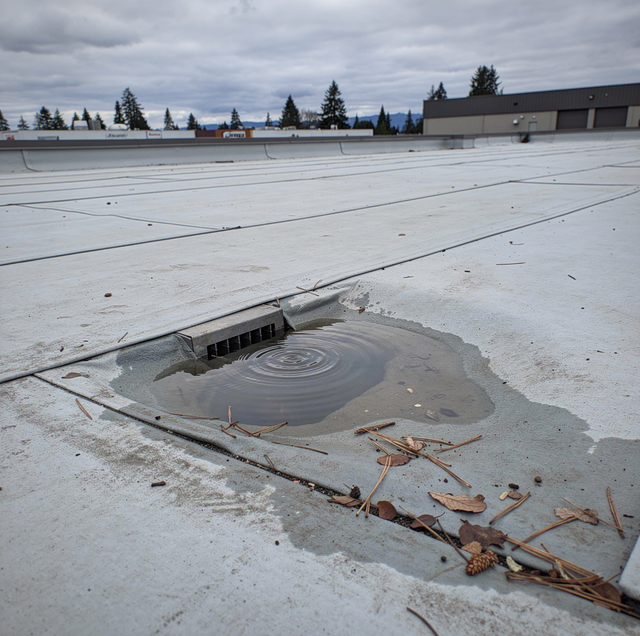
Ponding water on a flat roof for more than a day or two after rain, rather than draining away, is one of the fastest ways to shorten a membrane's life. Constant moisture speeds up the same UV and thermal breakdown described above, because a wet membrane holds heat differently than a dry one and cycles through expansion and contraction more often as puddles form and evaporate. Ponding also concentrates airborne debris, dirt, and organic material in one spot, trapping moisture against the membrane even between rain events. Over enough seasons, a membrane under a chronic ponding spot thins and softens faster than the surrounding field, and that weak point is almost always where the first leak shows up. A roof that drains within about 48 hours rarely develops this problem; one with even a shallow low spot near a drain will, given time.
How Foot Traffic and Mechanical Wear Break Down a Membrane
Flat roofs get walked on more than sloped roofs, whether for inspections, servicing rooftop equipment, or seasonal maintenance work, and every pass across the surface adds mechanical wear. Foot traffic compresses the membrane against whatever sits directly underneath it, and repeated compression over the same path, an access hatch to a rooftop unit, for example, thins the material faster there than anywhere else. Dropped tools, dragged equipment, and debris left on the surface add abrasion on top of that compression. None of this usually causes immediate damage, but it creates localized weak spots that age faster and are more likely to develop small punctures or splits first. Roofs with heavy equipment traffic benefit from walkway pads or designated paths that distribute wear across a protected surface rather than directly on the membrane.
Seam Integrity: The Weakest Point in Any Membrane System
A membrane roof is rarely a single, continuous sheet. It is built from multiple rolls joined together, and every seam is a point where two pieces of material must remain bonded for decades amid constant thermal movement. Seams fail through a few common paths: adhesive or weld bonds that were never fully cured during installation, thermal cycling that gradually works a seam edge loose over years, and standing water that sits on a seam line and works its way underneath through capillary action. A membrane field that still looks sound can have a compromised seam quietly letting water through, since seam failures often show up as a slow, hard-to-trace leak rather than an obvious tear. This is why seam inspection matters as much as checking the field itself, and why the original seaming work has an outsized effect on how long the whole system lasts.
Why Slope and Drainage Design Determine Long-Term Performance
Even a roof marketed as flat is built with a slight slope, engineered to move water toward drains, scuppers, or an edge rather than letting it collect on the field. When that slope is correct, and drains are properly sized and positioned, water has nowhere to sit for long, removing most of the ponding risk before it can start. Problems show up when the slope was miscalculated during design, when insulation underneath the membrane settles unevenly, or when drains were placed without accounting for how water moves across the roof. A genuine low spot away from any drain will pond in the same spot after every rain, regardless of how well the membrane material is holding up, because the issue is structural. Correcting a persistent drainage problem, sometimes by adding a secondary drain or reshaping insulation to redirect flow, does more for long-term membrane life than any surface-level fix applied afterward.
Installation and Seaming Quality Set the Ceiling on Lifespan
No membrane material, regardless of its rated lifespan on paper, performs to that rating if it was installed poorly. Correct installation means the membrane is fully adhered or mechanically fastened to specification, seams are welded or bonded at the right temperature and pressure, flashing at penetrations and edges is properly formed rather than improvised, and the deck underneath is dry and sound before the membrane goes down. A membrane installed over a damp deck, or seamed too quickly in cold weather without proper heat, can look identical to a correctly installed roof for a year or two before failing well ahead of schedule as those shortcuts catch up. Installation quality functions almost like a ceiling on the whole system: a premium membrane installed poorly will underperform a mid-tier material installed correctly.
The Role of Regular Inspection in Extending Membrane Life
Membrane roofs age gradually, which means most of the damage that eventually causes a leak is visible well before it becomes a problem, if someone is actually looking. A scheduled inspection checks for surface chalking or blistering; standing water and its exact location after rain; seam edges that have started to lift; punctures or abrasions along foot-traffic paths; and flashing at every penetration, drain, and roof edge. Catching a lifted seam edge or a small blister early means a targeted repair rather than a full leak investigation later. Inspection frequency matters more on flat roofs than sloped ones, because these failure modes all progress quietly and are far easier to spot up close than from the ground.
Why Small Repairs Done Promptly Prevent Big Failures
A membrane roof rarely fails due to a single dramatic event. It fails through small, unaddressed issues that compound: a pinhole puncture that lets moisture reach the insulation underneath, a lifted seam edge that slowly widens with every thermal cycle, a blister that eventually splits open under foot traffic. Each of these, caught early, is a minor patch. Left through several more seasons of expansion, contraction, and rain, the same issue can let enough moisture into the roofing system to compromise insulation and decking, at which point the fix is a larger structural one rather than a surface repair. Prompt response, rather than waiting for the next scheduled inspection or for an indoor leak, is one of the biggest factors separating a membrane that reaches its full lifespan from one that doesn't.
Protective Coatings and Their Effect on Membrane Longevity
A protective coating, applied over an existing membrane once it has aged past its original factory surface, adds a fresh UV-resistant and often reflective layer that slows the photodegradation described earlier. Coatings work best on a membrane that is still structurally sound but showing surface wear, since a coating restores surface protection without addressing seams or ponding issues that already exist underneath it. Reflective coatings reduce how hot the surface gets during the day, lowering the rate of thermal cycling and meaningfully extending the working life of an otherwise healthy membrane. Coatings are not a substitute for repairing seam failures or fixing drainage issues, but when layered onto a membrane in good condition, they add a genuine buffer against the same stresses that age any exposed roofing surface.
How Different Membrane Materials Age (TPO, EPDM, Modified Bitumen)
The three most common flat roof membrane materials age through the mechanisms above, but at somewhat different rates. TPO, a single-ply thermoplastic sheet, is typically heat-welded at seams, creating a strong bond when done correctly, though it can become more brittle with age depending on formulation. EPDM, a synthetic rubber membrane, is known for its flexibility and long track record, with seams historically bonded with adhesive tape or liquid adhesive. However, newer seam tape products have improved reliability. Modified bitumen combines asphalt with rubber or plastic modifiers and is typically installed in overlapping layers, either torched, heat-welded, or self-adhered, giving it a different seam profile than single-ply systems. None of these materials is immune to UV breakdown, ponding damage, or seam failure. The differences matter less for maintenance than the shared factors already covered: drainage, installation quality, inspection frequency, and how quickly small problems get addressed.
A Maintenance Checklist for Homeowners and Property Managers
- Walk the roof after any major storm and note whether water is pooling and how long it takes to drain.
- Check seam lines for lifting, separation, or visible gaps, especially near drains, edges, and rooftop equipment.
- Look at flashing around every penetration, vent stack, HVAC curb, and roof edge for cracking or separation.
- Clear debris, leaves, and dirt from the surface and out of drains and scuppers before it traps moisture.
- Note any blistering, chalking, or thinning on the membrane surface and track whether it's spreading.
- Keep foot traffic on designated pads or paths rather than crossing the open membrane field repeatedly.
- Schedule a professional inspection at consistent intervals rather than only after a leak appears indoors.
- Get any identified issue repaired promptly instead of letting it sit until the next scheduled visit.
Frequently Asked Questions
Service life depends on material and installation quality, but well-installed, properly maintained systems are designed to last multiple decades. Poor drainage, weak seaming, or ignored small repairs will cut that short.
Brief pooling that clears within a day or two after rain is normal on a properly sloped roof. Water that sits longer or reappears in the same spot after every storm points to a drainage issue worth addressing.
Yes, in most cases. Seam separations, isolated punctures, and localized blistering can typically be patched or re-welded without replacing the entire membrane, as long as the damage hasn't spread widely or reached the decking beneath.
Reflective coatings reduce surface temperature and slow UV-related breakdown, extending the working life of a membrane that's still structurally sound. They aren't a fix for existing seam or drainage problems, which need separate attention.
Most membrane systems benefit from at least two scheduled inspections a year, plus a check after any severe storm. Heavy foot traffic or known drainage concerns often warrant more frequent attention.
Waiting until a leak appears inside the building before acting. By then, moisture has usually been working through a compromised seam, puncture, or ponding area for a while, turning a small patch into a larger repair.
Schedule a flat roof membrane inspection — catch ponding, seam wear, and surface breakdown early, before they become bigger repairs. 3D Established Roofing serves Nanaimo, Lantzville, and Parksville. Call (236) 508-8008.
