
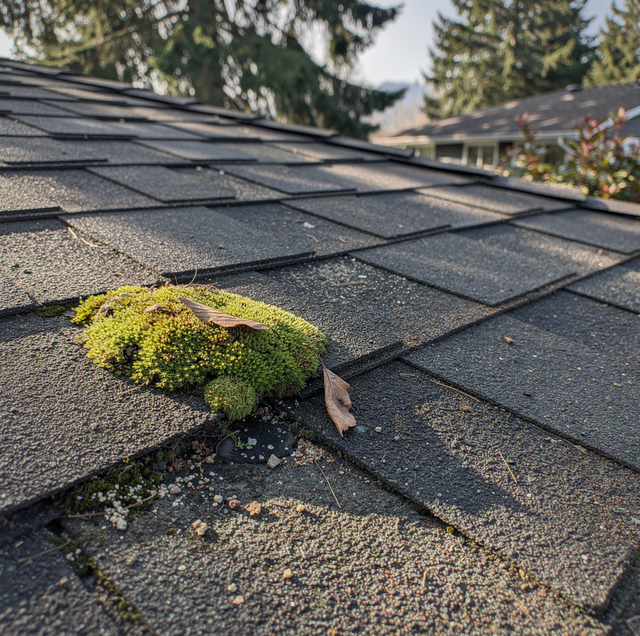
Moss and algae on a roof are often treated as a cosmetic nuisance, something to scrub off before a home sale or a neighbor's comment. That framing misses what is actually happening underneath the growth. Moss and algae are living organisms that interact with shingle material in ways that wear it down faster than sun and rain alone would. Understanding the mechanics behind that damage helps you decide when a patch of green fuzz is harmless and when it is quietly taking years off your roof.
What Moss and Algae Actually Are on a Roof
Algae, usually the blue-green type that leaves dark streaks on north-facing slopes, feeds on the limestone filler mixed into asphalt shingle granules. It spreads via airborne spores that land on damp surfaces and multiply in shaded, moisture-holding spots. Moss is a different organism entirely. It is a small, rootless plant that anchors itself with thread-like structures called rhizoids, which work their way into any crack, seam, or gap they can find. Both organisms need the same conditions to take hold: shade, organic debris such as leaf litter or pollen, and a shingle surface that stays damp for extended stretches. A roof that dries quickly after rain rarely develops heavy growth. One that holds moisture under tree cover or in a shaded valley almost always will, given enough time.
How Moss Physically Lifts and Separates Shingles
This is the part that surprises most homeowners. Moss does not just sit on top of a shingle; it grows into it. Those rhizoids push between the tabs and under the edges of overlapping shingles, prying them apart millimeter by millimeter as the moss cushion thickens. Once a shingle edge is lifted even slightly, wind can get underneath it, and wind-driven rain can work its way past the seal strip, which was designed to keep water moving down and off the roof rather than sideways and under it. A shingle that has been pried open by moss growth rarely reseals itself. The gap remains, and every subsequent rainfall has an easier path beneath the roofing layer than over it.
The Moisture Trap Under a Moss Mat
Asphalt shingles are built to shed water quickly and dry out between storms. A mat of moss fails to meet both of those design goals. It acts like a sponge, holding rainwater against the shingle surface long after a storm has passed and the rest of the roof has dried. That extended dampness softens the asphalt binder that holds granules in place and keeps the fiberglass or organic mat underneath saturated for far longer than the manufacturer's lifespan estimates assume. Shingles rated for a multi-decade service life are tested under normal wet-dry cycling, not under a permanently damp cushion. Roofing sections that stay wet for days rather than hours age noticeably faster, even though nothing about the shingle itself has changed.
Granule Loss and Why It Speeds Up Aging
Granules are not just for color. They shield the asphalt layer beneath from ultraviolet light, the primary cause of shingle brittleness and cracking over time. Algae colonies feeding on the limestone in those granules weaken the adhesive bond holding them to the shingle. Moss rhizoids working their way across the surface do the same thing mechanically, prying granules loose as they spread and anchor. Once granules wash away in the next rain, the exposed asphalt underneath has no shield left. It dries out, becomes brittle, and starts to crack far sooner than it would have with its granule coating intact. Granule loss is largely irreversible. You can remove the moss and algae that caused it, but the granules that already washed down the downspout are gone for good, and that section of roof is now aging faster than the rest.
Algae Staining Versus Real Structural Harm
It helps to separate two distinct problems that are often lumped together. Dark streaking from algae alone is mostly cosmetic in its early stages. It signals biological activity on the granule surface, but by itself it is not tearing the shingle apart the way moss can. The real damage from algae comes later, once granule loss from feeding activity has gone on long enough to expose bare asphalt in patches. Moss, on the other hand, causes both cosmetic and physical damage almost from the start, because its growth habit involves prying into the shingle structure rather than sitting on top of it. A roof with light algae staining and no moss is a lower-priority concern than a roof with even a small colony of moss establishing itself in a shaded valley or under an overhang.
Freeze-Thaw Stress on Chronically Damp Shingles
In climates where temperatures swing across the freezing point through the colder months, trapped moisture becomes a second problem layered on top of the first. Water held under a moss mat or between lifted shingle tabs freezes when the temperature drops, and expanding ice puts outward pressure on whatever surrounds it. That pressure works on already-weakened seal strips and granule beds, widening small gaps and knocking loose granules that algae feeding and moss rhizoids had already loosened. A shingle that might have handled one freeze-thaw cycle without issue can fail after repeated cycles once moss or algae has compromised its surface and its ability to dry out between cold snaps. This is one reason growth that looks minor in warmer months can translate into visible wear by the following spring.
Weight, Drainage, and Debris Buildup
Dry moss is light, but saturated moss holds a surprising amount of water relative to its size, adding sustained weight to the shingle layer and, in thick colonies, to the decking underneath. That added load is rarely enough on its own to threaten a structurally sound roof, but it compounds every other issue already at work: the moisture stays put, the lifted shingle edges remain lifted, and the load presses moss rhizoids further into any seam it has already opened. Moss and algae growth also traps falling leaves, pollen, and grit, creating a layer of organic material that holds even more water and feeds the next generation of growth. Debris and moss fragments that wash free in heavy rain frequently end up in gutters and downspouts, where they slow drainage and cause water to back up toward the roof edge instead of away from it.
Wood Rot Beneath Long-Term Growth
The slowest but most costly consequence of chronic moss and algae growth occurs entirely below the shingle layer. When a section of roof stays wet for months at a time because moss is trapping moisture against it, that dampness eventually seeps through compromised seams and lifted tabs to the underlayment and decking beneath. Wood exposed to sustained moisture develops rot over time, softening the deck and reducing its ability to hold fasteners securely. By the time rot in the decking becomes visible from inside an attic, the moss and algae that started the process have usually been active on the surface for a long stretch already. Catching surface growth early is far less costly than addressing deck rot once it has set in.
Warning Signs Worth Checking For
You do not need to climb onto the roof to spot most early warning signs. Dark streaking on north-facing slopes, especially near vents or chimneys, indicates algal activity. Green or grey-green cushioning along shingle edges, in valleys, or under overhanging branches indicates moss that is likely already anchored to the shingle surface. Granules collecting in gutters or at the base of downspouts after rain is a sign that granule loss is underway, whether from algae, moss, or normal aging. Shingle tabs that look slightly raised or uneven compared to the surrounding field, particularly in shaded sections, suggest moss has already started prying them apart. None of these signs demand an immediate emergency response, but each one is worth a closer look before the next wet season sets in.
Slowing Regrowth Between Cleanings
Removing existing moss and algae only solves half the problem if the same shade and moisture conditions remain. Trimming back overhanging branches that keep a section of the roof in near-constant shade lets that area dry faster after rain, removing one of the two conditions growth depends on. Keeping gutters and valleys clear of leaf litter and organic debris removes a food and moisture source. Zinc or copper strips installed near a ridgeline release trace metal ions into rainwater runoff that inhibit new moss and algae growth on the slopes below, extending the time between cleanings without any ongoing effort. None of these steps repair damage that has already occurred, but together they slow the rate at which new growth re-establishes itself after a roof has been cleaned.
Frequently Asked Questions
No. Light algae streaking on its own is usually a surface-level cosmetic issue in its early stages. It becomes a bigger concern once it has been present long enough to cause noticeable granule loss, which is worth checking for separately.
Moss removal needs to account for the fact that rhizoids are already anchored into the shingle surface. Carelessly pulling or scraping moss off can take granules and even shingle material with it, so gentle, low-pressure methods are generally safer than aggressive scrubbing or high-pressure washing.
Given consistent shade and moisture, moss spores can take hold within a single wet season, though visible cushioning that starts lifting shingles usually takes longer to develop. Roofs with heavy tree cover and poor airflow are the most likely to see faster establishment.
No. Once granules have washed away, they cannot be reattached. The affected section of shingle is permanently more exposed to ultraviolet light and will age faster than surrounding, fully granulated areas for the rest of its service life.
They are most effective on asphalt shingle roofs, where rainwater runoff carries trace metal ions down the slope. Their effectiveness depends on rainfall frequency and roof layout, since areas that runoff does not reach will not get the same protective benefit.
Yes, that spot deserves attention even if the rest of the roof looks fine. Valleys concentrate water flow, and moss growing there can divert runoff toward seams and flashing rather than off the roof, which makes it a higher-priority area than the same amount of growth on an open, sun-exposed slope.
Schedule a roof moss and algae inspection — a trained crew can check for granule loss, lifted shingles, and early moisture damage before it becomes a bigger repair. 3D Established Roofing serves Nanaimo, Lantzville, and Parksville. Call (236) 508-8008.
